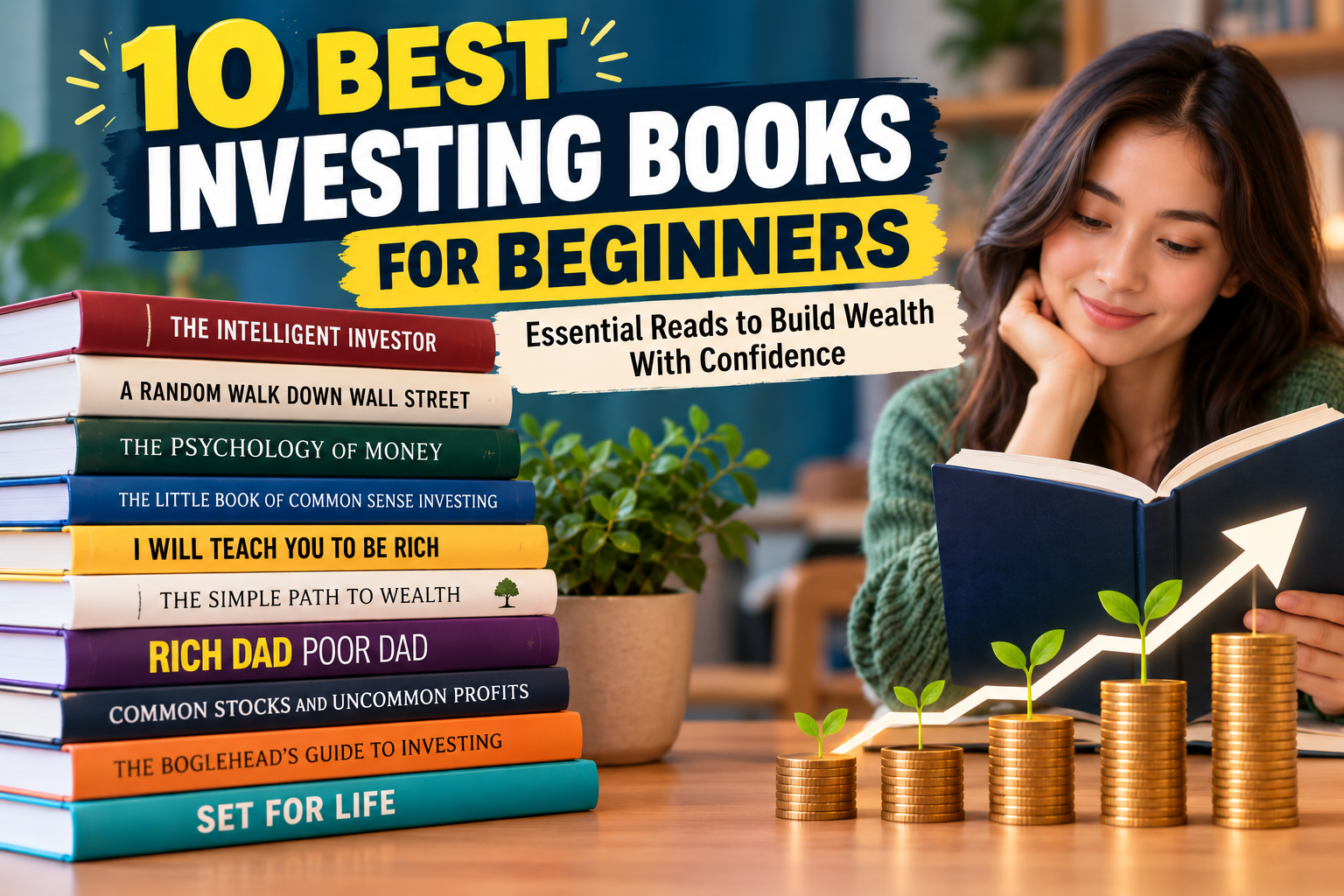
You don’t need to become a Wall Street expert to start investing. But when you’re new to the financial world, it can be hard to know where to start. With thousands of stocks, countless investment strategies, and financial advice coming from every direction, making your first investment decision can feel like navigating an unfamiliar city without a map.
That’s where the best investing books for beginners can make a difference.
Table of Contents
A well-written investing book can explain complicated financial concepts in language you actually understand. It can show how disciplined investors grow wealth over time, while others face setbacks by chasing short-lived investment trends. More importantly, it can help you develop the patience, financial habits, and decision-making skills needed to pursue your long-term goals.
One important lesson beginners often miss is that building investment knowledge doesn’t require a high income—you can start learning to make smart financial decisions regardless of how much you earn.
Imagine you’re 25 years old, earning $50,000 annually, and wondering whether you should contribute more to your employer’s 401(k), open a Roth IRA, or buy your first shares of stock. You might have dozens of questions but no clear idea where to find reliable answers. Instead of relying entirely on financial influencers or random online recommendations, you can learn from authors who have spent years studying investment markets, investor behavior, and personal finance.
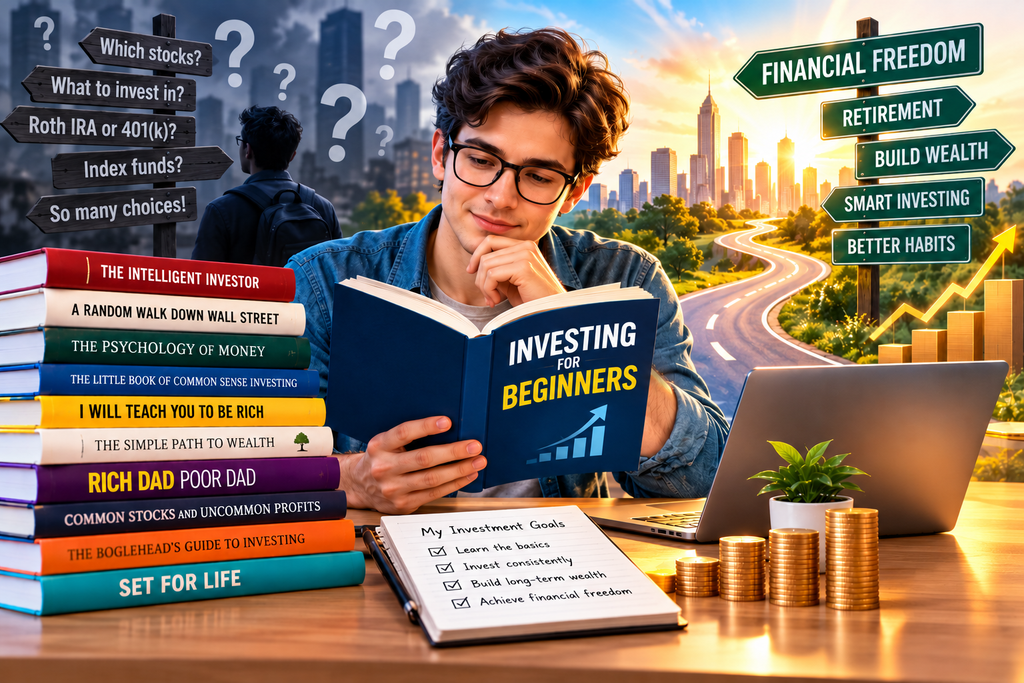
The best investing books for beginners offer different perspectives on building wealth. Some explain how to invest in low-cost index funds. Other books examine how emotions influence investment choices, teach readers how to evaluate individual stocks, and explain how everyday money management habits can support long-term financial growth.
This guide introduces ten outstanding investing books, explains what each one teaches, and shows how you can apply their lessons to everyday financial decisions in the United States.
Whether you’re investing your first $100 or preparing to strengthen your retirement savings, these books can help you become a more informed and confident investor.
Before putting your savings into the stock market, it’s helpful to understand what you’re actually buying and why. Successful investing involves much more than buying shares in a company, waiting for their value to rise, and selling them to make money. It involves balancing potential rewards against uncertainty, managing your emotions, and making decisions that support your financial future.
Why the Best Investing Books for Beginners Are Worth Reading
The best investing books for beginners introduce these ideas without requiring you to understand advanced mathematics or financial analysis. These books offer valuable insights into how various investment options work, what causes financial markets to decline, and how to make informed decisions to reduce potential investment risks. They also challenge the mistaken belief that successful investing always requires constant trading or predicting the next major market movement.
Think about learning to cook. You could begin by combining random ingredients and hoping for a delicious meal, but understanding basic cooking techniques would make the process much easier. Investing works similarly. Learning foundational principles doesn’t guarantee a profitable outcome, but it can help you avoid decisions based entirely on guesswork.
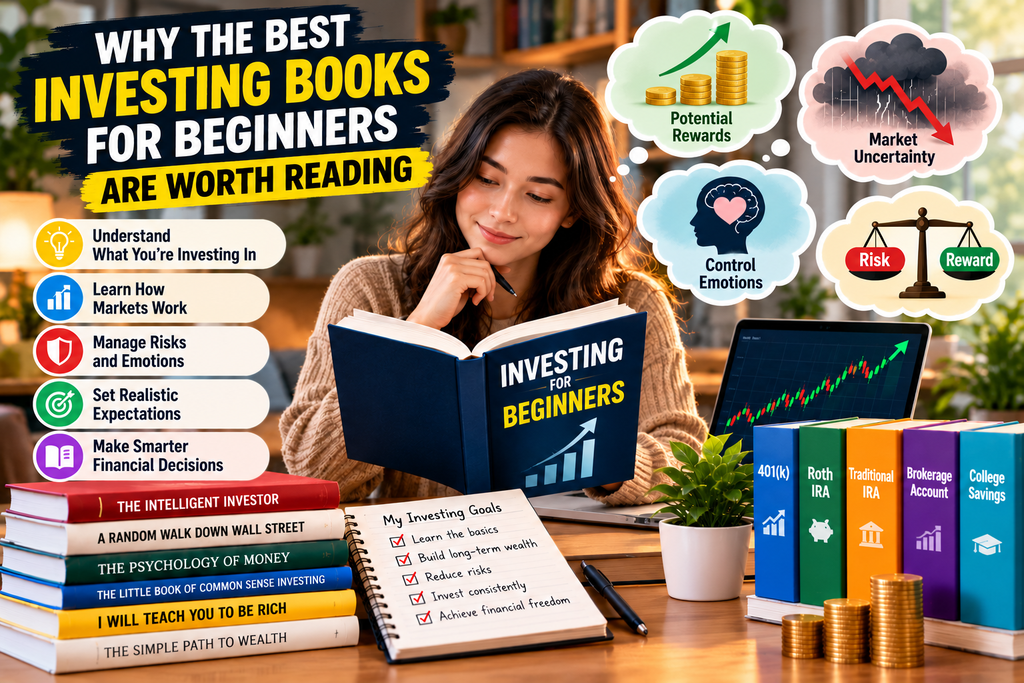
Another benefit of reading investing books is developing realistic expectations. Online success stories sometimes make investing appear effortless, especially when someone claims to have doubled their money in a few months. What those stories may leave out are the risks, losses, and unusual circumstances behind the results. Good financial education encourages you to evaluate both the potential rewards and the possibility of losing money.
For American readers, investment knowledge is particularly valuable when making decisions about employer-sponsored retirement plans, traditional and Roth IRAs, taxable brokerage accounts, and college savings. Every investment account is designed to meet specific financial needs and comes with its own tax benefits, requirements, and regulations.
How Understanding Investing Can Help You Avoid Costly Financial Mistakes
Picture a 29-year-old office employee in Arizona who earns $65,000 per year and wants to invest for retirement. After hearing friends discuss a popular technology stock, the employee considers putting an entire $8,000 savings balance into that company. If the stock rises, the decision might appear brilliant. But if the business encounters serious problems, a substantial portion of those savings could disappear.
Now consider how the employee’s approach might change after understanding the importance of diversification. Rather than putting the entire savings amount into a single company’s stock, the employee could consider investing in a fund that spreads the money across shares of multiple businesses. That choice would not eliminate stock market losses, but it could reduce the impact of problems affecting one particular company.
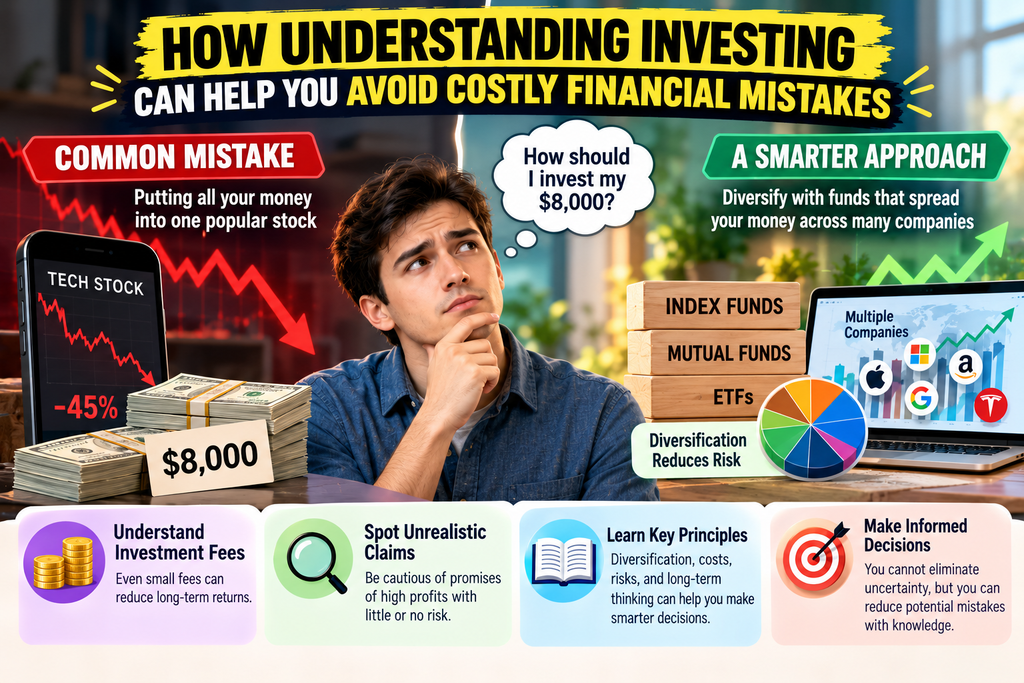
The best investing books for beginners also explain why investment expenses matter. Mutual funds and exchange-traded funds may charge annual management expenses that reduce investor returns. Trading costs, account charges, and certain advisory fees can create additional expenses.
Even a minor difference in investment fees can gradually reduce your potential earnings, especially when your money stays invested for many years. Understanding these costs helps you compare investment options more carefully.
Learning about personal finance helps you recognize investment claims that sound too good to be true. When someone promises exceptionally high profits with little or no chance of losing money, treat it as a warning sign and carefully investigate the opportunity before making any financial commitment.
The goal isn’t to eliminate uncertainty. It’s to make financial decisions with a clearer understanding of what could happen.
1. The Psychology of Money by Morgan Housel
Best for: Understanding the emotional side of investing.
Main lessons: Financial behavior, patience, risk, and the meaning of wealth.
What if your biggest obstacle to becoming a successful investor isn’t a lack of financial knowledge but the way you react to money?
Morgan Housel explores this important idea in The Psychology of Money, revealing how our thoughts, emotions, and everyday financial habits influence the way we manage and invest money.
Rather than focusing mainly on numbers, formulas, and complex investment strategies, this book examines the powerful connection between human behavior and financial success. Through engaging real-life examples and thought-provoking stories, Morgan Housel explains how our financial choices are often influenced by past experiences, personal beliefs, emotional reactions, and uncertainty about the future instead of careful reasoning alone.
This approach makes it one of the best investing books for beginners, particularly for readers who feel uncomfortable with financial terminology.
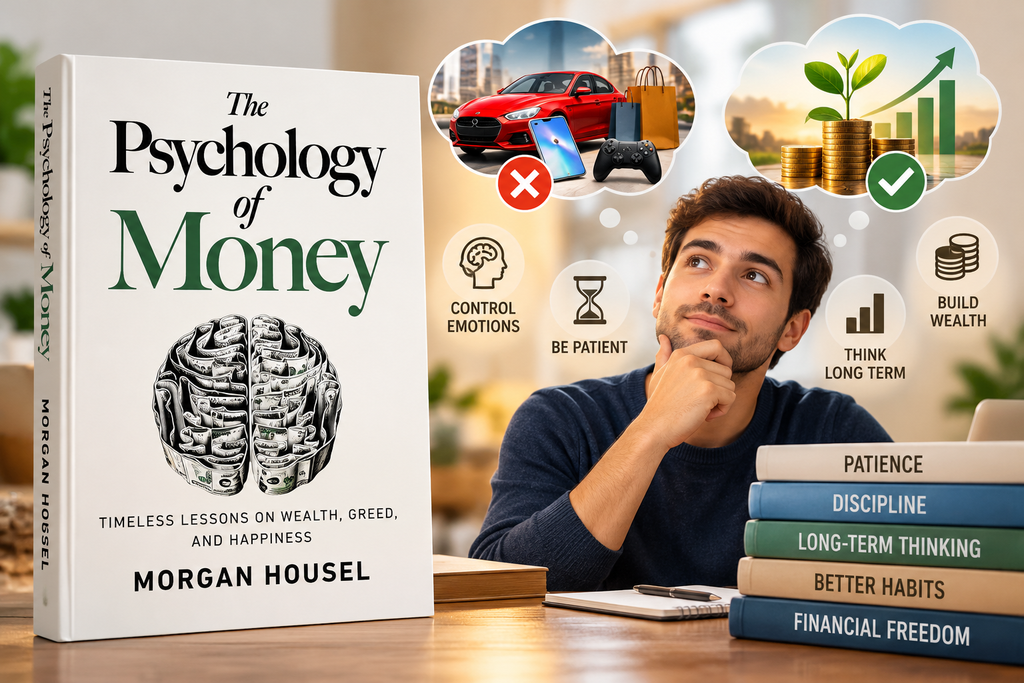
One of the book’s strongest themes is that earning money, accumulating wealth, and preserving wealth require different habits. A person might earn an impressive salary but struggle financially because spending increases whenever income rises. Someone with a more modest income might build considerable savings by keeping expenses manageable and investing consistently.
Consider two friends who graduate from college and begin working in Denver. Both earn approximately $55,000 annually. One frequently upgrades vehicles, purchases expensive electronics, and spends heavily on entertainment. The other keeps everyday expenses under control and sets up automatic transfers from each paycheck to build retirement savings over time.
Neither person’s financial future is predetermined. However, the second person is developing habits that may support greater financial flexibility over time.
Housel emphasizes how patience and a long-term perspective can give investments greater opportunities to increase in value over time. Short-term market fluctuations can make investors anxious, especially when account balances decline. Understanding that uncertainty is a normal part of investing can help people avoid making decisions based solely on fear.
What beginners can learn:
- Your spending habits influence how much you can invest.
- Patience matters when pursuing long-term financial goals.
- Financial security is not the same as displaying expensive possessions.
- Emotional decisions can undermine a carefully designed investment plan.
Among the best investing books for beginners, this is an excellent first choice because it focuses on the person making financial decisions, not just the investments being purchased.
2. The Simple Path to Wealth by JL Collins
Best for: Learning a straightforward approach to long-term investing.
Main lessons: Index funds, financial independence, and avoiding unnecessary complexity.
Some investing advice makes wealth building sound like a full-time job. You might be told to monitor stock charts, follow economic announcements, and constantly search for the next successful company.
JL Collins offers a different perspective in The Simple Path to Wealth.
His message is that investors can pursue long-term financial growth without making their portfolios unnecessarily complicated. Collins encourages investors to avoid the difficult task of picking individual stocks and instead spread their investments across the broader stock market using affordable index funds.
This practical philosophy makes the book one of the best investing books for beginners who want an understandable investment strategy.
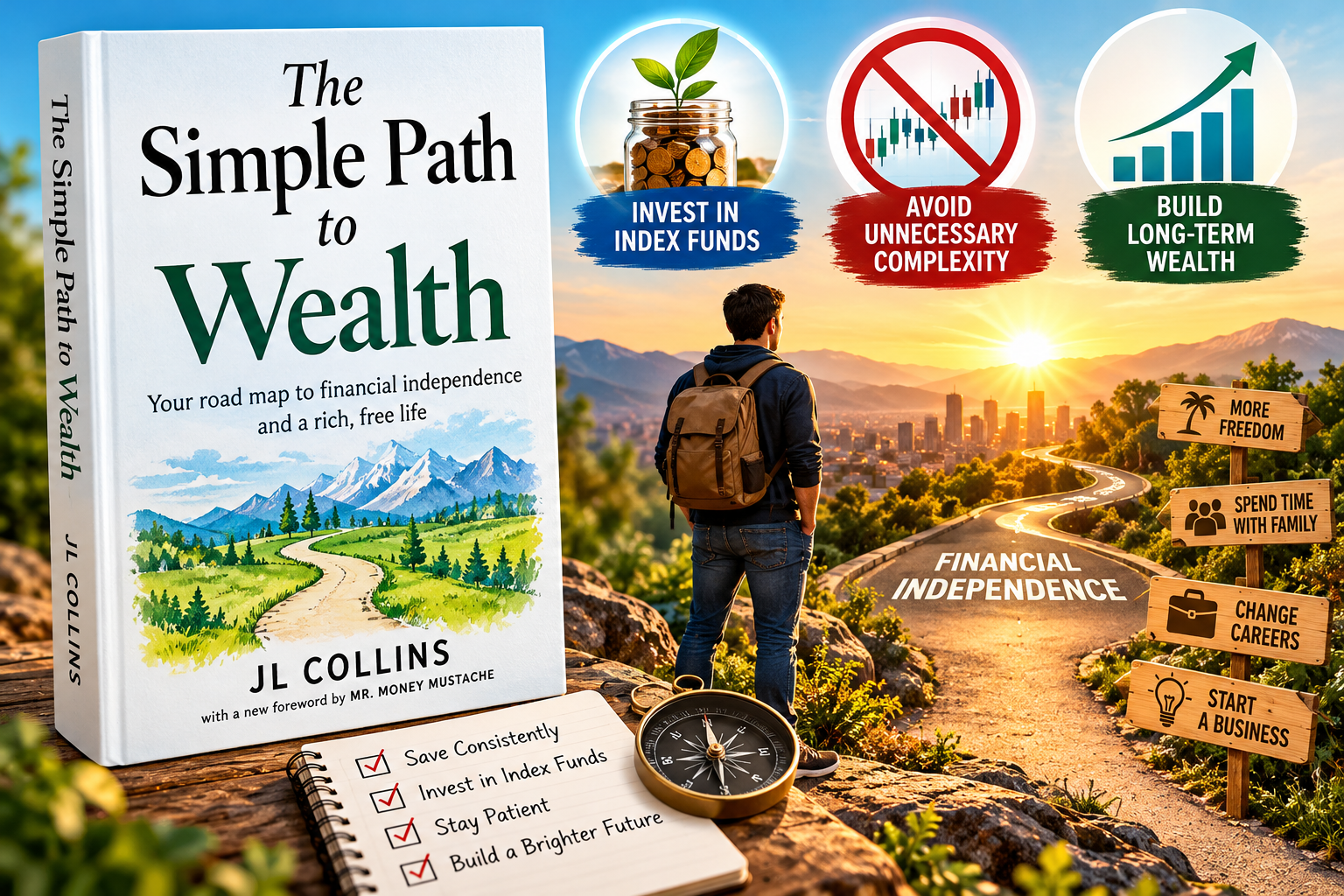
An index fund is designed to follow the performance of a particular market index. For example, a total U.S. stock market index fund provides exposure to a broad collection of American publicly traded companies. When you purchase shares in such a fund, your investment is spread across many businesses rather than depending on one company’s success.
Imagine a 32-year-old electrician in Michigan who wants to begin investing $300 monthly. The electrician works long hours and doesn’t have much interest in studying corporate earnings reports every weekend.
A diversified index fund may provide a more manageable option than researching dozens of individual stocks. The investor would still need to consider market risk, investment expenses, and the appropriate balance between stocks and other assets.
Collins also connects investing with financial independence. For some people, independence means retiring before the traditional retirement age. For others, it means having enough savings to change careers, start a business, or spend more time with family.
The central lesson is that building financial security can give you greater freedom to make decisions about your life and future.
What beginners can learn:
- A complicated portfolio isn’t automatically a better portfolio.
- Broadly diversified index funds can simplify investment decisions.
- Consistent saving supports long-term financial progress.
- Financial independence involves flexibility, not just a large account balance.
If you’re searching for the best investing books for beginners that explain how to build a relatively simple investment strategy, Collins’ book deserves serious consideration.
3. The Little Book of Common Sense Investing by John C. Bogle
Best for: Understanding low-cost investing.
Main lessons: Diversification, index investing, and controlling fees.
John C. Bogle helped change the investment industry by promoting low-cost index funds for ordinary investors. His investment philosophy questioned the belief that achieving solid long-term returns requires hiring costly financial experts to choose individual stocks on your behalf.
In The Little Book of Common Sense Investing, Bogle explains why many beginners pay far too little attention to investment expenses.
Suppose you invest in two funds that provide similar market exposure. One has an annual expense ratio of 0.05%, while the other charges 0.90%. The difference may look insignificant when expressed as a percentage, especially if you’re investing a relatively small amount.
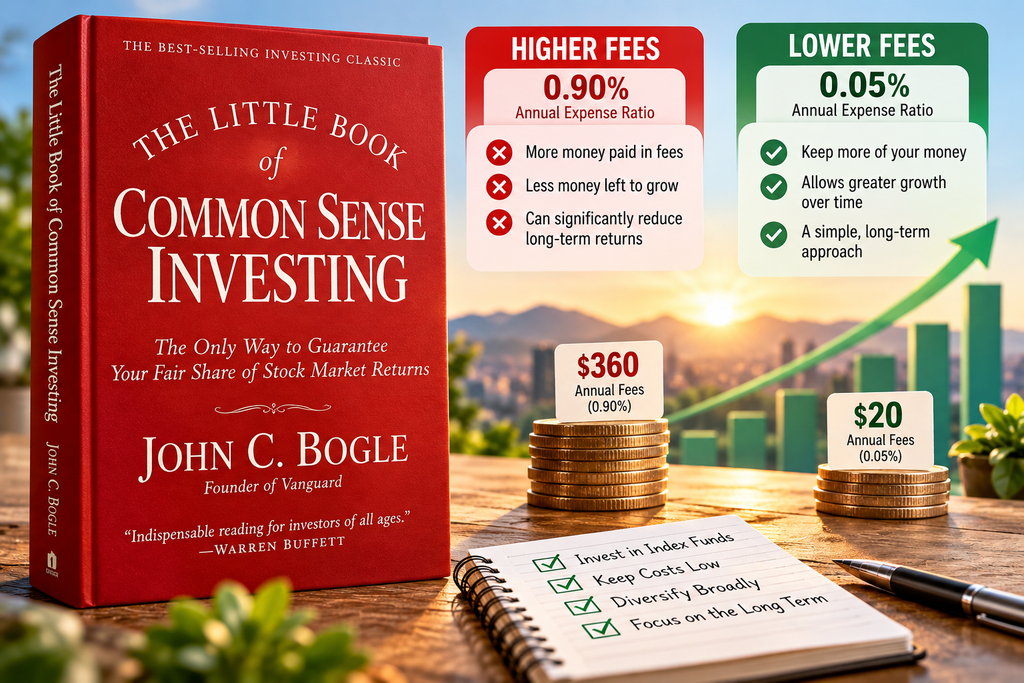
However, fund expenses are deducted from investment assets and can reduce the amount available for future growth. As your portfolio grows, the dollar value of those expenses may also increase.
Consider an investor with a $40,000 portfolio. A 0.05% expense ratio represents approximately $20 annually at that balance, while a 0.90% expense ratio represents approximately $360. These figures don’t include other possible fees or changes in portfolio value.
The difference becomes particularly important over long investment periods.
Bogle also encourages investors to recognize how difficult it can be to consistently outperform the broader stock market. Instead of spending time searching for top-performing fund managers year after year, investors may choose broadly diversified index funds that aim to mirror the performance of major market indexes.
For Americans contributing to 401(k) plans or IRAs, these lessons are especially useful when comparing available investment options.
What beginners can learn:
- Investment fees reduce the money available to grow.
- Index funds offer a way to obtain broad market exposure.
- Frequent trading isn’t required for long-term investing.
- A disciplined investment strategy can be more manageable than constant market predictions.
Among the best investing books for beginners, Bogle’s work is particularly valuable for understanding why seemingly minor costs deserve careful consideration.
4. The Intelligent Investor by Benjamin Graham
Best for: Understanding how to evaluate investments and manage risk.
Main lessons: Value investing, business fundamentals, and investment discipline.
Buying a stock because its price has been rising isn’t necessarily a sound investment strategy. Before committing money to a company, you should understand what the business does, how it earns revenue, and whether its share price makes sense.
Benjamin Graham explores these questions in The Intelligent Investor, a classic work that has influenced generations of investors, including Warren Buffett.
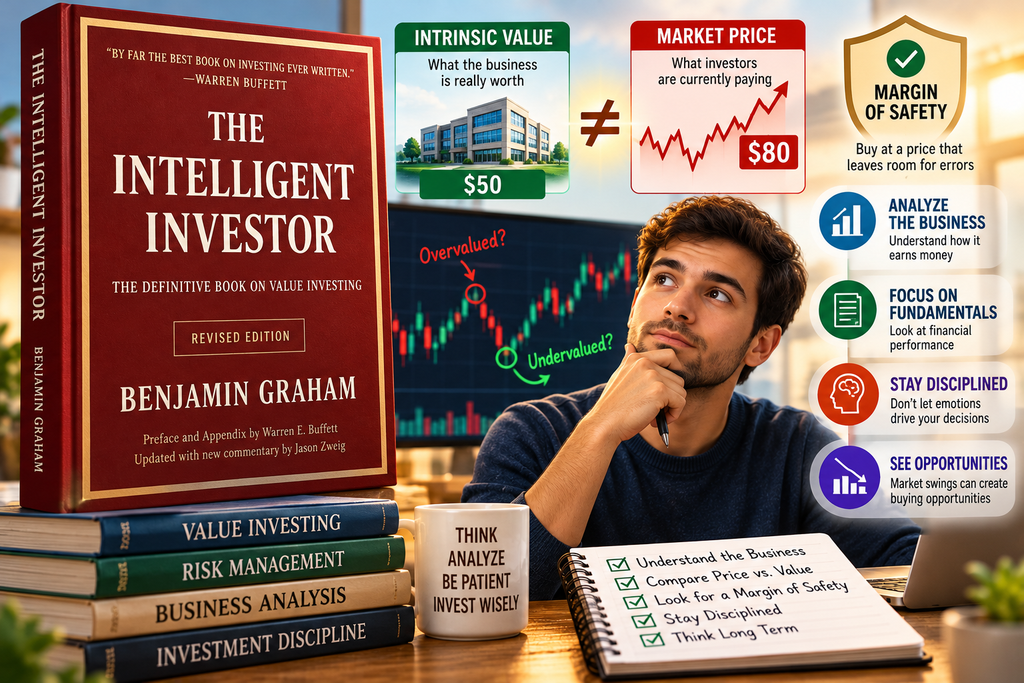
Graham’s approach emphasizes the difference between a company’s stock market price and its estimated underlying value. Those figures aren’t always identical. Investors sometimes become overly enthusiastic about promising businesses, pushing their stock prices beyond what the companies’ financial performance may justify.
The opposite can happen when investors become frightened during economic uncertainty.
One important concept in the book is the margin of safety. Graham encourages investors to consider purchasing securities at prices that leave room for errors in their estimates. This doesn’t guarantee protection against losses, but it introduces a more cautious approach to evaluating potential investments.
Imagine you’re considering buying a small rental property in Tennessee. Before making an offer, you would probably examine its condition, rental income, maintenance expenses, and comparable property prices. You wouldn’t automatically assume the seller’s asking price represents the property’s true value.
Graham encourages a similar mindset when analyzing businesses.
Another memorable lesson involves treating changing market prices as opportunities to evaluate rather than commands to act. A company’s share price can experience dramatic ups and downs, even when its underlying business performance and future growth potential remain largely unchanged.
Among the best investing books for beginners, this title is more challenging than most. Beginners who haven’t yet learned how to interpret company financial statements may find Graham’s ideas easier to understand after reading a simpler book that explains the basics of investing.
What beginners can learn:
- A stock’s market price and estimated business value can differ.
- Financial analysis helps investors evaluate potential opportunities.
- Emotional market movements shouldn’t automatically control your decisions.
- Protecting investment capital deserves attention alongside pursuing returns.
5. A Random Walk Down Wall Street by Burton G. Malkiel
Best for: Understanding why predicting stock prices is difficult.
Main lessons: Market behavior, diversification, asset allocation, and investment research.
Every year, financial commentators make confident predictions about interest rates, stock market performance, and which industries will deliver the highest returns. Occasionally, these market forecasts accurately reflect what happens in the financial markets. Many others don’t.
Burton G. Malkiel examines the difficulty of consistently forecasting market movements in A Random Walk Down Wall Street.
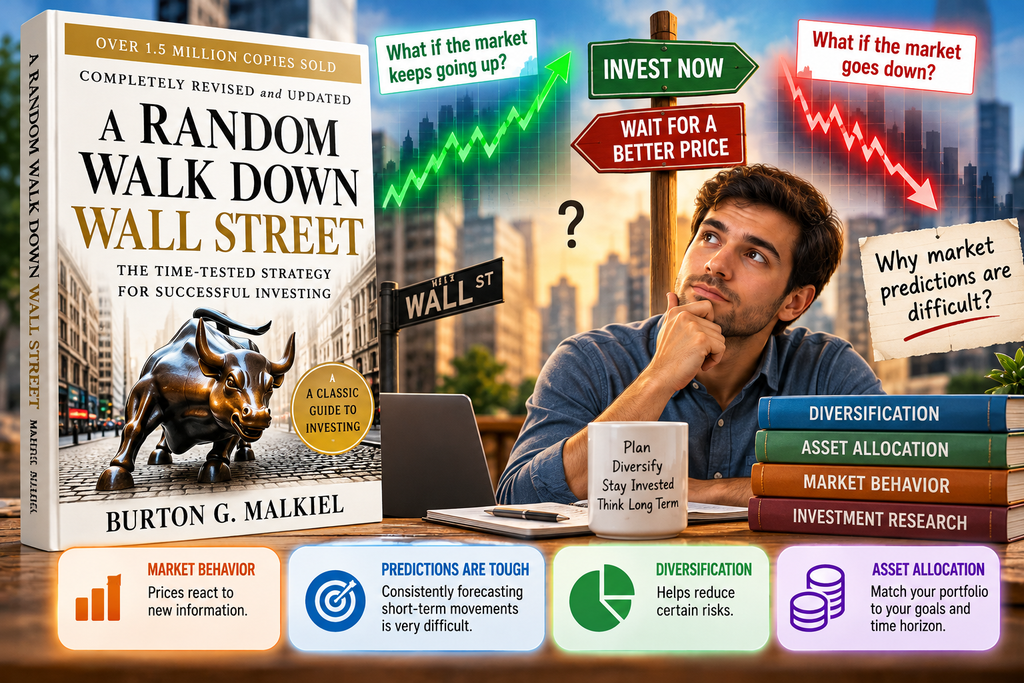
This book helps beginners understand how new information affects stock market movements and why accurately predicting future investment performance is so challenging.
For example, imagine an investor in Seattle who has $15,000 available for a long-term investment. After reading several negative economic forecasts, the investor decides to wait until stock prices fall substantially before purchasing anything.
But what happens if the market continues rising for another two years?
Waiting may cause the investor to miss potential growth. Of course, investing immediately could also result in losses if prices decline soon afterward. The challenge is that neither outcome can be predicted with certainty.
Malkiel’s discussion helps beginners understand why building a diversified portfolio may be more practical than repeatedly trying to identify perfect buying and selling opportunities.
The book also introduces asset allocation, which involves dividing investment money among categories such as stocks, bonds, and cash.
A 28-year-old saving for retirement several decades away may have different investment needs from a 61-year-old expecting to retire soon. Their time horizons, financial obligations, and ability to tolerate market declines could justify different portfolio allocations.
Among the best investing books for beginners, Malkiel’s work is especially useful for readers who enjoy understanding the research and reasoning behind common investment recommendations.
What beginners can learn:
- Financial markets react to changing information.
- Consistently predicting short-term stock prices is difficult.
- Diversification can reduce certain investment risks.
- Portfolio allocation should reflect personal goals and circumstances.
6. The Bogleheads’ Guide to Investing by Taylor Larimore, Mel Lindauer, and Michael LeBoeuf
Best for: Turning basic investing knowledge into a practical plan.
Main lessons: Portfolio construction, retirement accounts, diversification, and financial planning.
Understanding investment terminology is helpful, but eventually you’ll want to know how to put that knowledge into practice.
That’s where The Bogleheads’ Guide to Investing becomes particularly valuable.
Inspired by John Bogle’s investment principles, this guide explains how individuals can organize their finances and approach investing with a long-term perspective. The book brings together essential investing concepts that may initially confuse new investors, explaining how retirement planning, investment fees, asset allocation, and regular portfolio reviews contribute to a well-organized financial strategy.
Imagine a married couple in Virginia who recently started saving for retirement. Both spouses have access to workplace retirement accounts, and they also want to understand whether opening IRAs would be beneficial.
Their challenge isn’t necessarily choosing the next successful stock. They need to determine how much to contribute, what investment options are available, and how their accounts fit together.
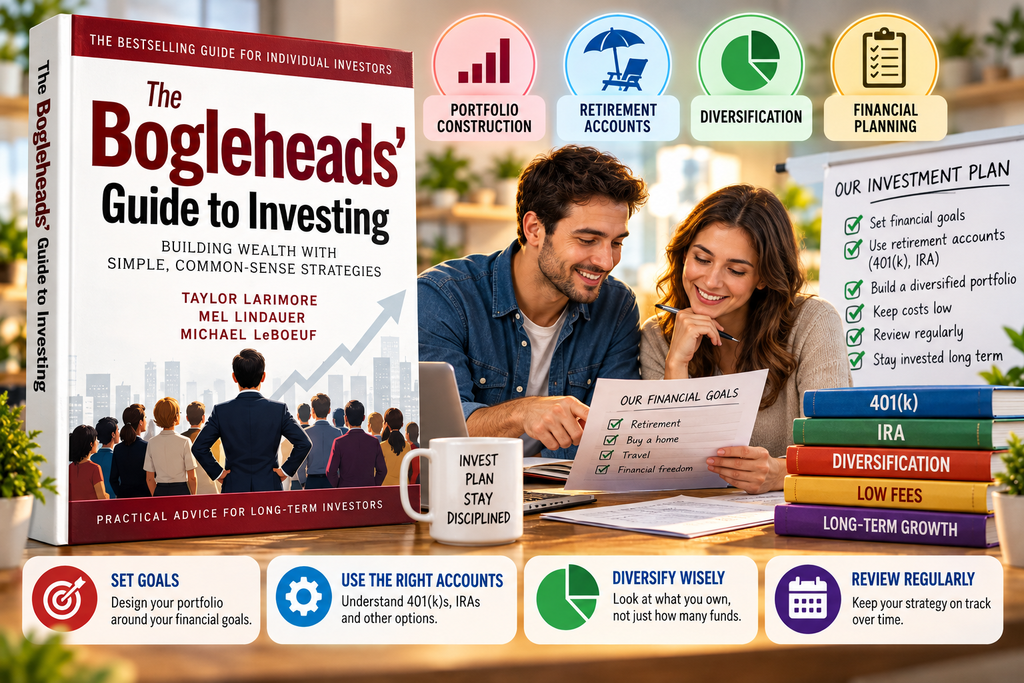
The book offers practical guidance to help beginners evaluate their options and make informed decisions about their financial future.
One particularly useful concept is that owning numerous investments doesn’t automatically mean your portfolio is properly diversified. Several mutual funds might hold many of the same large American companies, creating more overlap than expected.
To build a properly diversified portfolio, it’s more important to examine what each fund actually holds than to focus solely on how many different funds you own.
The guide also emphasizes keeping an investment strategy manageable. For some people, a diversified portfolio containing a small number of broadly focused funds may be easier to maintain than a collection of specialized investments.
That simplicity can be valuable when markets become volatile, and investors feel tempted to make frequent changes.
Among the best investing books for beginners, this guide is an excellent choice for readers who want to connect financial education with practical retirement planning.
What beginners can learn:
- Different investment accounts serve different purposes.
- A portfolio should be designed around financial goals.
- Diversification depends on what investments you own.
- Periodic reviews can help maintain an appropriate investment allocation.
7. One Up on Wall Street by Peter Lynch
Best for: Learning how to research individual companies.
Main lessons: Business analysis, stock selection, and identifying potential investment opportunities.
Have you ever noticed a small business becoming increasingly popular and wondered whether its success could translate into an investment opportunity?
Peter Lynch explores this idea in One Up on Wall Street.
Lynch, who previously managed Fidelity’s Magellan Fund, explains how investors can use everyday observations as starting points for researching businesses.
Perhaps you work in healthcare and notice increasing demand for a particular medical technology. For example, working in a retail store might show you that shoppers repeatedly choose a particular brand over similar products offered by competing companies.
These observations may reveal businesses worth investigating.
However, Lynch’s investment philosophy doesn’t suggest that liking a company’s products is enough reason to invest in its stock without first evaluating its financial health and growth potential.
Consider a grocery store chain expanding rapidly throughout the Midwest. Its stores appear busy, customer reviews are positive, and new locations continue opening.
Before investing in a company’s shares, it’s important to assess its financial performance, including sales growth, earnings, outstanding debt, business expansion expenses, market competitiveness, and whether its stock price reflects a reasonable valuation.
Even a financially strong and growing business may deliver poor investment returns if you pay more for its stock than its underlying value can reasonably justify.
This distinction is one of the most useful lessons for beginners interested in stock picking.
Lynch also encourages investors to understand the types of companies they own. Businesses with steady earnings may behave differently from rapidly expanding companies or businesses whose performance depends heavily on economic cycles.
Among the best investing books for beginners, One Up on Wall Street provides a useful introduction to evaluating individual stocks without requiring readers to become professional financial analysts.
What beginners can learn:
- Everyday experiences can inspire investment research.
- Product popularity doesn’t automatically indicate an attractive stock.
- Business fundamentals matter when evaluating companies.
- Different companies present different opportunities and risks.
8. I Will Teach You to Be Rich by Ramit Sethi
Best for: Young adults learning to manage money and invest consistently.
Main lessons: Financial automation, intentional spending, banking, and retirement saving.
Knowing how to invest won’t help much if you never have money available to invest.
That’s one reason I Will Teach You to Be Rich belongs on this list.
Ramit Sethi approaches wealth building by helping readers organize their everyday finances. His book covers spending, saving, banking, and investing as connected parts of a larger financial system.
Instead of expecting readers to monitor every dollar constantly, Sethi encourages creating financial routines that make good habits easier to maintain.
For example, imagine a 24-year-old software support employee in Boston earning $54,000 annually. Rent, groceries, student loan payments, and transportation expenses consume much of the monthly paycheck.
Investing may seem impossible because there’s rarely a large amount left at the end of the month.
By examining recurring expenses and setting up automatic contributions, the employee might discover that investing $75 per paycheck is manageable.
The amount may appear small, but establishing a consistent habit can be more useful than waiting for a future salary increase before getting started.
Sethi also discusses spending according to personal priorities. Instead of eliminating every enjoyable purchase, readers are encouraged to identify which expenses genuinely improve their lives and which provide little lasting value.
For Americans starting their careers, the book can also introduce important retirement account concepts.
As of 2026, the IRS sets the basic annual IRA contribution limit at $7,500 for eligible individuals under age 50, subject to applicable eligibility and income rules. For 2026, employees participating in most 401(k) retirement plans can contribute up to $24,500 of their earnings, excluding any additional catch-up contributions for eligible older workers.
Among the best investing books for beginners, Sethi’s book is particularly helpful for readers who need to strengthen their financial habits before increasing investment contributions.
What beginners can learn:
- Automating financial decisions can support consistency.
- Investing should fit within a realistic spending plan.
- Retirement accounts can provide tax advantages.
- Managing everyday expenses creates room for future financial goals.
9. The Richest Man in Babylon by George S. Clason
Best for: Building basic saving and money management habits.
Main lessons: Financial discipline, controlling expenses, and protecting savings.
Not every valuable financial lesson requires modern technology, complicated investment products, or detailed stock market analysis.
The Richest Man in Babylon uses stories from an ancient setting to communicate ideas about earning, saving, and managing money.
The book’s characters face financial challenges that remain recognizable today. They struggle with spending, debt, financial obligations, and the desire to improve their circumstances.
One of its central lessons is to reserve a portion of your income for your future rather than spending everything you earn.
Consider a 31-year-old delivery driver in Kentucky who takes home approximately $3,500 per month. After covering housing, transportation, groceries, and other essential expenses, the driver wants to establish a regular savings habit.
Setting aside 5% of monthly take-home pay would mean saving $175. Over twelve months, that would amount to $2,100 before any interest or investment returns.
That money might initially help build an emergency fund rather than immediately entering the stock market.
Once the driver has established appropriate cash reserves and addressed expensive debt, additional savings could potentially support long-term investments.
The book also emphasizes caution when considering unfamiliar financial opportunities.
That lesson is relevant when online advertisements promise extraordinary investment returns or promote complicated products without clearly explaining their risks.
Among the best investing books for beginners, The Richest Man in Babylon is most useful as a foundation for financial discipline. It won’t teach you how to analyze ETFs or choose retirement investments, but it can help you develop habits that make investing possible.
What beginners can learn:
- Saving regularly creates financial opportunities.
- Spending decisions influence future investment capacity.
- Understanding risk is essential before committing money.
- Building wealth requires consistent financial habits.
10. The Millionaire Next Door by Thomas J. Stanley and William D. Danko
Best for: Understanding the difference between high income and accumulated wealth.
Main lessons: Lifestyle choices, saving behavior, and long-term financial independence.
When people imagine a millionaire, they often picture luxury cars, expensive watches, and enormous houses.
But appearances can be misleading.
The Millionaire Next Door examines the financial behavior of affluent Americans and challenges popular assumptions about what wealth looks like.
One of the book’s most important ideas is that earning a substantial income doesn’t automatically mean accumulating substantial assets.
Imagine two households in suburban Georgia. Both earn $120,000 annually, but their financial decisions differ.
The first household finances expensive vehicles, frequently upgrades home furnishings, and spends heavily on vacations. The second maintains lower recurring expenses and regularly contributes to retirement and investment accounts.
After twenty years, their financial positions could look dramatically different, even though their annual incomes were similar.
Of course, real-life wealth accumulation is influenced by more than spending choices. Healthcare costs, housing prices, wages, family responsibilities, and unexpected financial difficulties can affect how much households are able to save.
The book’s research also reflects historical circumstances, so readers should avoid assuming that every observation applies equally to today’s Americans.
Its broader message, however, remains valuable: Financial security is better measured by what you own and owe than by how expensive your lifestyle appears.
Among the best investing books for beginners, this book is useful for readers who want to understand how everyday financial choices influence long-term wealth accumulation.
What beginners can learn:
- A high salary doesn’t guarantee financial independence.
- Lifestyle expenses can limit investment contributions.
- Net worth provides a different perspective from annual income.
- Consistent saving can support long-term wealth accumulation.
Quick Comparison of the Best Investing Books for Beginners
The best investing books for beginners cover different aspects of financial education. Some focus on investment products and strategies, while others explore financial behavior and money management. The following table can help you identify which books fit your current goals.
| Book | Primary Focus | Ideal Reader | Difficulty |
| The Psychology of Money | Financial behavior | Complete beginners | Easy |
| The Simple Path to Wealth | Index fund investing | Long-term investors | Easy |
| The Little Book of Common Sense Investing | Investment costs | Index fund beginners | Easy–Moderate |
| The Intelligent Investor | Value investing | Aspiring stock analysts | Challenging |
| A Random Walk Down Wall Street | Market behavior | Curious investors | Moderate |
| The Bogleheads’ Guide to Investing | Portfolio planning | Retirement savers | Easy–Moderate |
| One Up on Wall Street | Stock research | Individual stock investors | Moderate |
| I Will Teach You to Be Rich | Financial organization | Young professionals | Easy |
| The Richest Man in Babylon | Saving habits | New savers | Easy |
| The Millionaire Next Door | Wealth accumulation | Long-term planners | Easy |
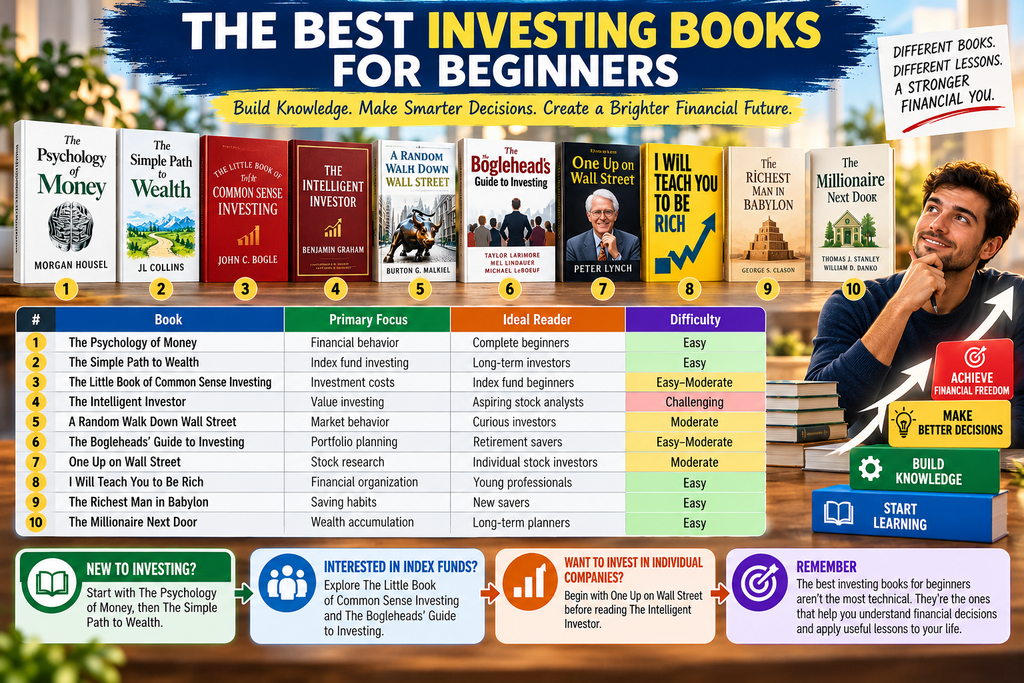
If you’re completely new to investing, consider starting with The Psychology of Money before moving to The Simple Path to Wealth. These books introduce the behavioral and practical foundations of investing without requiring extensive financial knowledge.
Readers who want to understand diversified investment funds may benefit from John Bogle’s work. Those interested in building a retirement portfolio can explore The Bogleheads’ Guide to Investing.
If you’re more interested in individual companies, One Up on Wall Street offers an approachable introduction before tackling the more demanding material in The Intelligent Investor.
The best investing books for beginners aren’t necessarily the most technical or widely praised. They’re the ones that help you understand financial decisions and apply useful lessons to your circumstances.
How to Choose the Right Investing Book for Your Financial Goals
Before choosing your next financial book, consider what you actually want to learn.
Are you trying to understand how the stock market operates? Are you looking to start building a retirement fund that will support your financial needs in the future? Are you interested in buying individual company shares, or would you prefer a relatively simple investment approach?
Your answers can help narrow the choices.
Someone who struggles to save consistently may benefit more from I Will Teach You to Be Rich than from a detailed guide to company valuation. On the other hand, someone who already contributes regularly to retirement accounts may be ready to explore asset allocation or investment analysis.
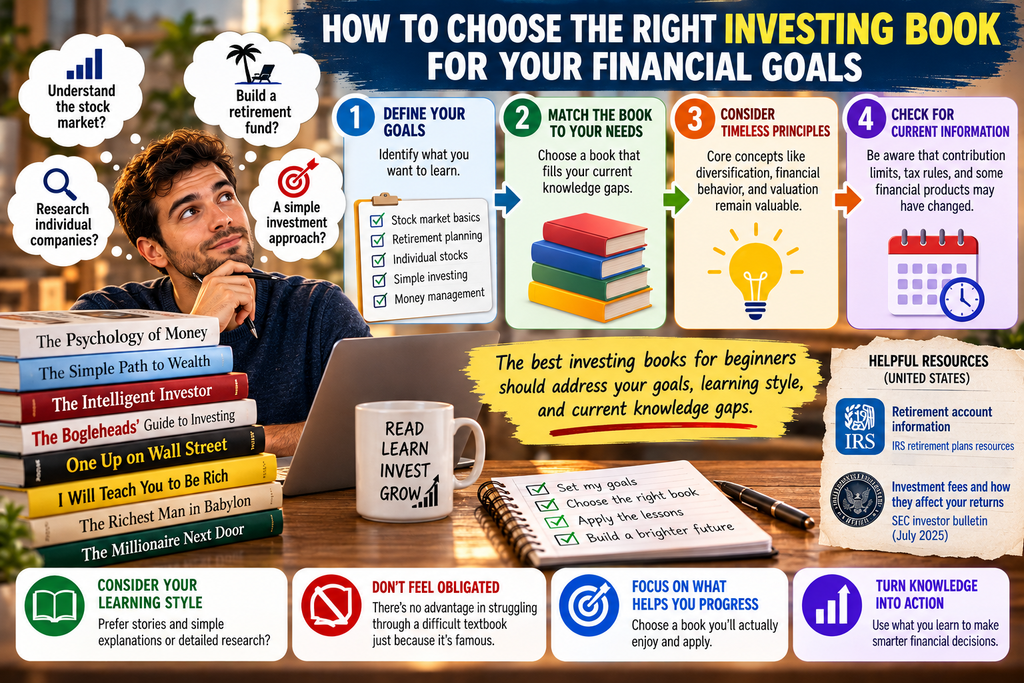
The best investing books for beginners should address your current knowledge gaps rather than simply add more information to your reading list.
It’s also important to distinguish between timeless investment principles and details that change over time.
A book published years ago may still explain diversification, financial behavior, or investment valuation effectively. However, specific retirement contribution limits, tax rules, and financial products may have changed since publication.
For current U.S. retirement account information, consult the IRS retirement plans resources. For guidance about investment fees, the SEC’s July 2025 investor bulletin explains how charges can affect portfolio growth.
It’s equally important to consider which learning methods make it easiest for you to understand and remember new financial concepts. If financial terminology makes you uncomfortable, start with a conversational book that uses stories. If you enjoy detailed research, choose a book that explains financial markets or business valuation more thoroughly.
There is no advantage in struggling through a difficult investment textbook simply because it has a famous title.
A Simple 30-Day Plan to Turn Reading Into Investing Knowledge
You don’t have to read ten books in one month to become a better-informed investor. A manageable learning schedule can be more useful than rushing through hundreds of pages without remembering the lessons.
During the first week, choose one of the best investing books for beginners and read for approximately twenty minutes each day. Focus on understanding the author’s main ideas rather than memorizing every financial term.
During the second week, review your personal finances. Identify your take-home income, essential expenses, outstanding debts, and existing savings. This information will help you determine whether you are financially prepared to begin investing.
During the third week, study basic investment products. Learn how stocks, bonds, mutual funds, ETFs, and retirement accounts differ. You can also compare investment expenses and examine how diversification affects risk.
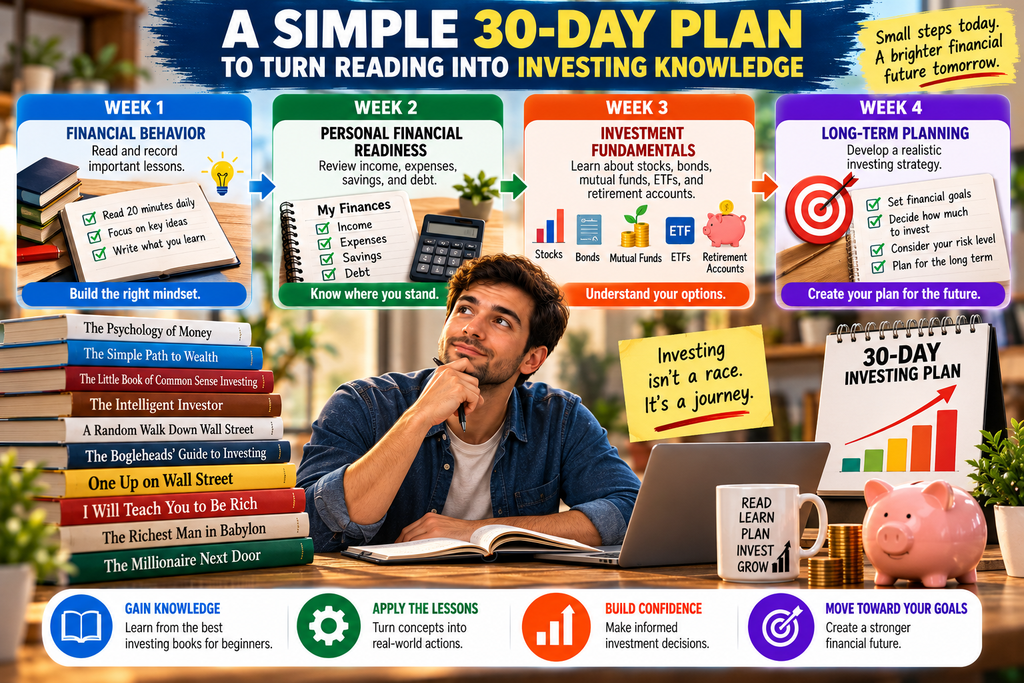
During the fourth week, begin developing a long-term financial plan. Decide which goals matter most, how much money you may be able to invest regularly, and whether you need additional guidance before opening an account.
| Week | Learning Priority | Practical Activity |
| Week 1 | Financial behavior | Read and record important lessons |
| Week 2 | Personal financial readiness | Review income, expenses, savings, and debt |
| Week 3 | Investment fundamentals | Research diversified funds and account types |
| Week 4 | Long-term planning | Develop a realistic investing strategy |
Remember that investing isn’t a race. Someone who begins with modest contributions and a clear understanding of risk may be better prepared than someone who invests aggressively without knowing what they own.
The best investing books for beginners can help you establish that understanding, but the real value comes from applying what you learn.
Conclusion
Learning to invest doesn’t require expensive financial courses, complicated trading software, or a background in economics. It begins with understanding how money works, recognizing investment risks, and developing habits that support your financial goals.
The best investing books for beginners offer different ways to build that foundation. Morgan Housel explains why financial behavior matters. JL Collins and John Bogle introduce relatively straightforward approaches to long-term investing. Benjamin Graham and Peter Lynch explore the process of evaluating individual businesses, while other authors explain how saving and lifestyle choices affect wealth accumulation.
You don’t need to agree with every author or adopt every investment strategy. Reading different perspectives can help you identify which principles make sense for your situation.
Start with one book that answers your most pressing questions. Give yourself time to understand its lessons, compare those ideas with reliable financial resources, and gradually develop an investment approach that fits your goals.
The most valuable result of reading the best investing books for beginners isn’t simply knowing more financial terminology. It’s becoming better equipped to make thoughtful decisions about your money and your future.
Frequently Asked Questions About the Best Investing Books for Beginners
1. Which investing book should a complete beginner read first?
If you’re completely new to investing, Morgan Housel’s The Psychology of Money is an excellent first read for understanding how financial habits, emotions, and decision-making influence long-term wealth building. It introduces financial behavior, patience, and decision-making through accessible stories. Readers who prefer practical information about investment products may want to begin with The Simple Path to Wealth instead. Both are among the best investing books for beginners because they explain important concepts without requiring advanced financial knowledge. The better choice depends on whether you want to understand your financial habits first or learn how to approach long-term investing.
2. Can I learn investing entirely from books?
Books can provide an excellent introduction to investing, but they shouldn’t be your only source of information. Financial regulations, tax rules, account features, and investment products change over time. Reading the best investing books for beginners can help you understand lasting principles, while current educational resources from the SEC and IRS can clarify specific rules. You may also benefit from reviewing fund prospectuses and learning how brokerage accounts operate. If your financial situation involves complicated tax or retirement decisions, a qualified professional may provide additional guidance.
3. How much money should a beginner invest every month?
There isn’t one monthly investment amount that works for everyone. Your appropriate contribution depends on your income, essential expenses, debt obligations, emergency savings, and financial goals. Depending on their financial circumstances, some beginners may start investing just $25 or $50 a month, while those with more money available after expenses might be able to contribute several hundred dollars regularly. The best investing books for beginners generally emphasize consistency and financial planning rather than requiring a particular starting amount. Avoid investing money needed for immediate living expenses, and consider how much investment risk you can reasonably tolerate.
4. Are index funds a good choice for new investors?
Diversified index funds can be a practical option for beginners because they provide exposure to a collection of securities without requiring investors to select individual companies. Many index funds also have relatively low operating expenses, although costs and investment objectives vary. However, index funds are not risk-free, and their values can decline when the markets they track fall. Several of the best investing books for beginners, including works by John Bogle and JL Collins, explain the potential advantages of index investing. Your investment choices should reflect your time horizon, financial goals, and tolerance for losses.
5. How much time do beginners need to learn the essential principles of investing?
Many people can begin understanding essential investment concepts within a few weeks of focused reading. Learning the differences between stocks, bonds, mutual funds, ETFs, and retirement accounts doesn’t require years of study. However, developing confidence and sound financial judgment is an ongoing process. The best investing books for beginners can provide a strong starting point, but experience, continued education, and thoughtful decision-making remain important. Rather than trying to master every strategy immediately, focus on understanding fundamental principles and building your knowledge gradually.