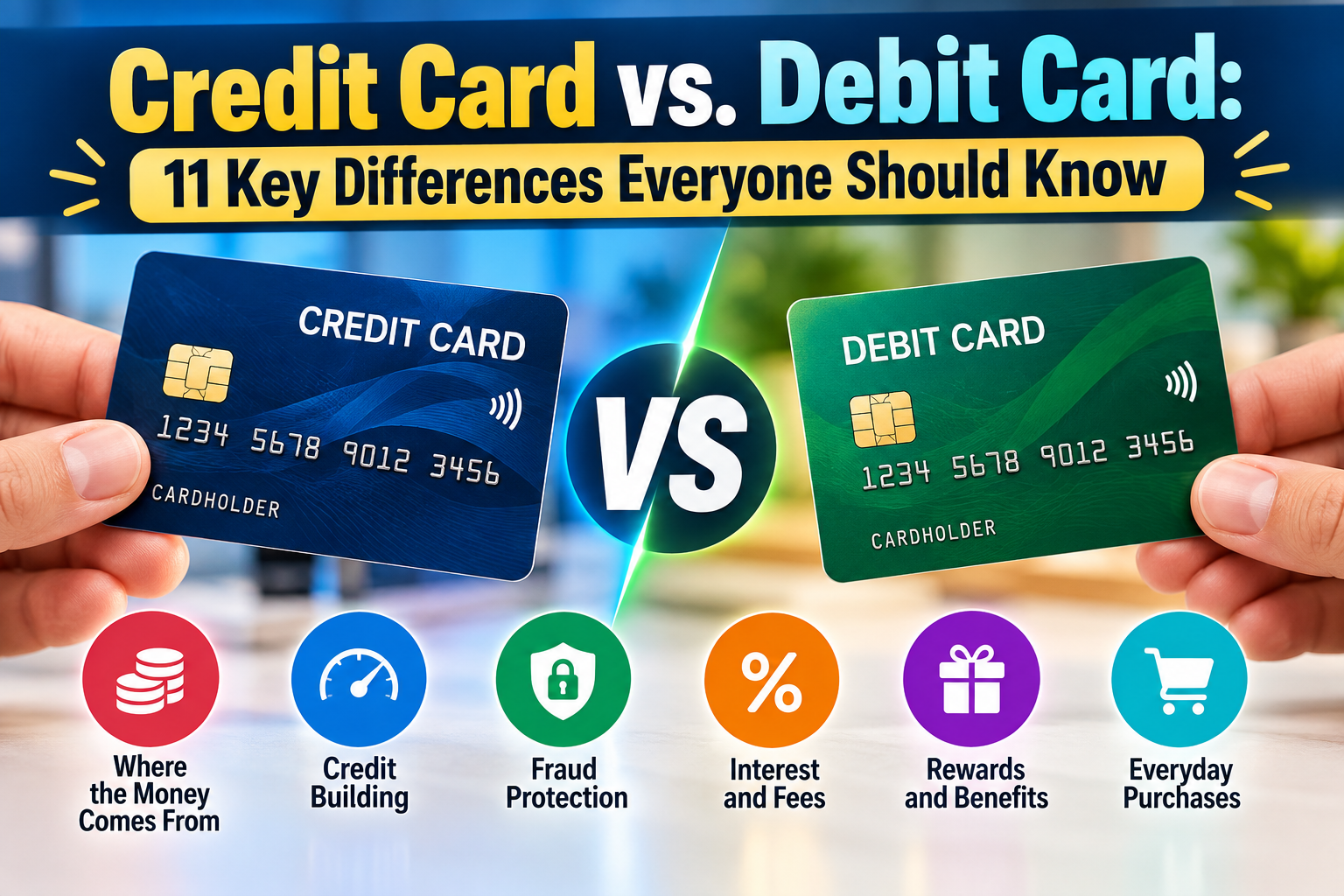
At first glance, a credit card and a debit card may appear quite similar. Both can be kept in the same wallet, used at millions of stores, linked to digital wallets, and facilitate quick online payments. However, there is a significant difference in the underlying transaction processes. One card typically allows you to spend against a line of credit, while the other directly deducts funds from your checking account. This fundamental distinction impacts your cash flow, potential interest costs, fraud risk, rewards or benefits, and credit history.
Table of Contents
For Americans, the credit card vs. debit card decision comes up almost every day. Would you use a debit card or a rewards-bearing credit card for an $85 grocery run at Walmart? What about a $1,200 laptop ordered online, a hotel room for a weekend getaway, or a monthly streaming subscription? No hard-and-fast rule requires you to use the same card for every purchase; instead, the smart approach is to understand how each payment method works and choose wisely.
Cards also dominate consumer transactions in the United States. According to data from the Federal Reserve Financial Services, credit cards accounted for 35 percent and debit cards for 30 percent of total transactions in 2024, while cash usage stood at 14 percent. U.S. consumers conducted an average of 48 transactions per month, and the increased use of credit cards contributed to a rise in the overall volume of transactions.
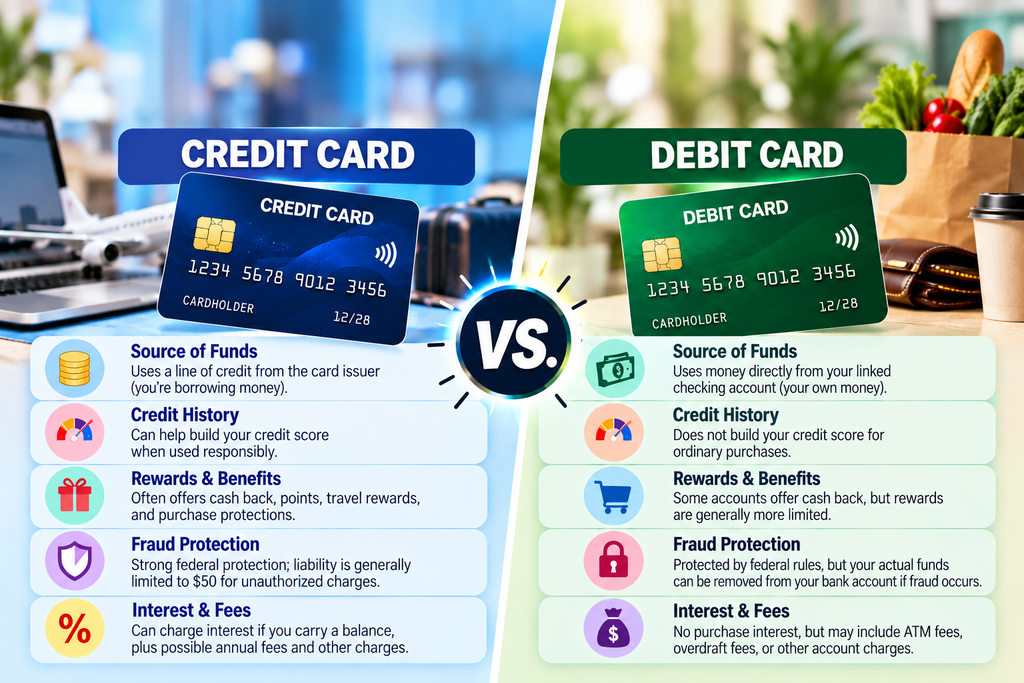
So, the credit card vs. debit card question is not merely about which piece of plastic you pull from your wallet. The key factors are whose money you are spending, what happens if a problem arises, and whether the payment creates any debt. This guide explains these differences using real-world examples from the United States, helping you choose the right payment method for various situations.
1. Credit Card vs. Debit Card: Why the Difference Matters
The experience at the checkout counter might seem much the same. You tap your card, insert it, or type in the card number; then the transaction is approved, and you leave with your purchase. But financially, a credit card vs. debit card transaction follows two different paths. With a debit card, the money typically comes from funds held in your linked bank or credit union account. On the other hand, with a credit card, the card issuer pays the merchant and adds the transaction amount to your outstanding balance.
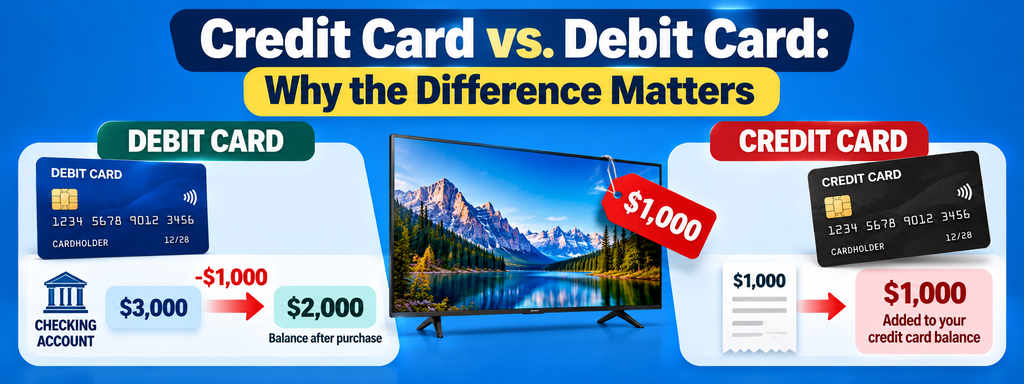
Suppose you have $3,000 in your checking account and want to buy a television costing $1,000. If you pay using a debit card, your checking account balance will decrease by approximately $1,000 as soon as the transaction is completed. If you use a credit card instead, that $3,000 will not be immediately deducted from your checking account; instead, a $1,000 liability will be created on your credit card account, which must be paid later in accordance with the card’s terms and conditions.
This distinction can be advantageous, but it can also carry risks. Using a credit card does not make a $1,000 television cheaper; if you carry a balance and incur interest charges, you could end up paying more than the item’s original price. On the other hand, if your credit card offers a “grace period” on purchases—and you qualify for it—you can usually avoid paying interest by paying off the full balance by the due date. According to the CFPB, most credit cards offer such a grace period for purchases, although card issuers are not required to provide it.
Understanding this distinction is the foundation of any useful credit card vs. debit card comparison. No card changes the actual price of a product at the cash counter, but the financial outcome can differ significantly depending on the financing and management of the purchase.
2. What Is a Credit Card?
A credit card is a type of payment card linked to a ‘line of credit’ rather than drawing directly from your checking account balance. The card issuer sets a specific spending limit (credit limit) for you; when you make a purchase, that amount is deducted from your available credit limit and remains reduced until the outstanding balance is paid off. For instance, suppose your card limit is $5,000, and you spend $800 on a purchase. Excluding any other transactions, you would have approximately $4,200 of that limit remaining—until your available credit increases again through a payment or credit.
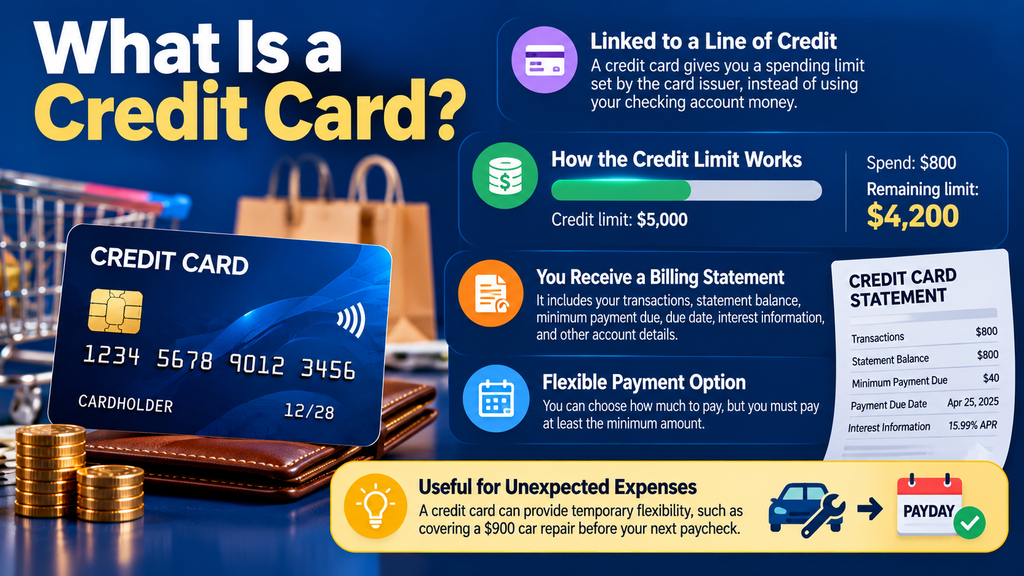
This is one of the most important ideas in the credit card vs. debit card debate: a credit card transaction involves borrowing. When you swipe the card, the expense is not automatically paid from the funds in your checking account. Instead, you receive a billing statement detailing your transactions, statement balance, minimum payment due, payment due date, interest information, and other account details. You then decide how much to pay—though you are required to pay at least the specified minimum amount.
The option to defer payment can be quite useful. For instance, suppose you incur an unexpected car repair cost of $900 on a Monday, but your paycheck doesn’t arrive until Friday. A credit card offers a level of temporary flexibility that a debit card cannot provide if your bank account lacks sufficient funds. However, if the outstanding balance carries over from one month to the next, this convenience can eventually turn into a costly debt burden. Therefore, a credit card should generally be viewed as a tool for making payments and managing credit, rather than as a source of additional income.
How a Credit Card Works
Let’s consider a simple example. Maria receives a regular salary and uses her credit card for groceries, fuel, phone bills, and occasional online shopping. In a single billing cycle, she spends a total of $1,500. By the time she receives her statement, she has sufficient cash on hand to pay off the entire outstanding balance by the due date. Assuming these purchases fall within the card’s “grace period” and she adheres to the terms of that period, she can avoid paying interest on these purchases.
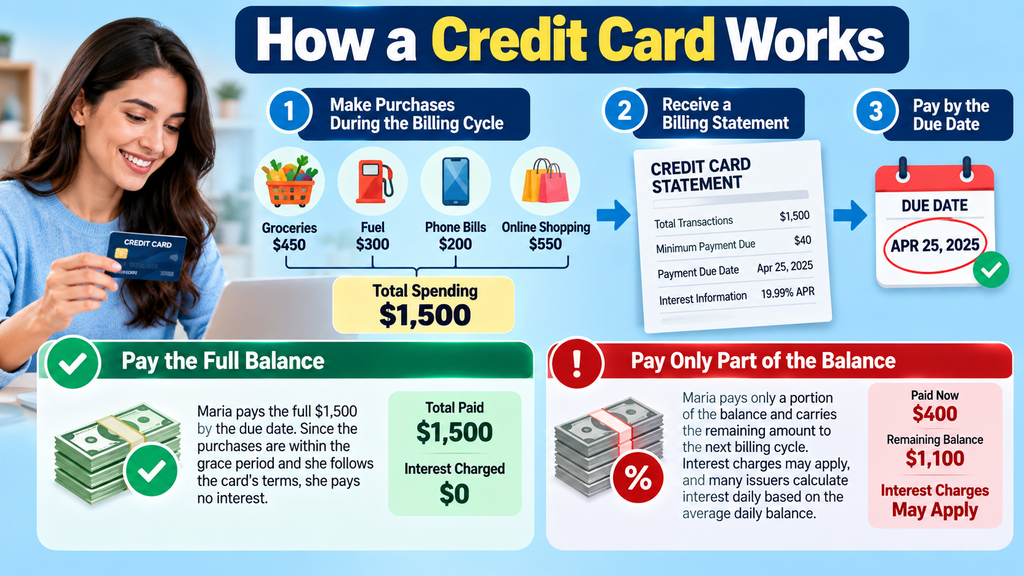
Now, imagine that Maria pays only a portion of the outstanding amount and carries over the remaining eligible balance to the next billing cycle. Interest charges may also come into play in this scenario. According to the CFPB, many card issuers calculate interest daily based on the account’s “average daily balance”; furthermore, different interest rates may apply to purchases, cash advances, and other types of transactions. That is a crucial consideration when comparing credit card vs. debit card, because an ordinary debit-card purchase does not create a revolving credit-card balance on which purchase interest accumulates.
That is why the phrase “I am buying this on my card” warrants a second thought. If you already have the necessary funds and regularly pay off the full outstanding balance, the card can simply serve as a medium between your purchases and your bank account. However, if you lack the funds and are considering incurring debt or carrying over a balance, you are effectively making two decisions at once: to make a purchase and to take on debt.
3. What Is a Debit Card?
Debit cards are typically linked directly to a checking account at a bank or credit union. Instead of borrowing money from the card issuer for everyday purchases, you generally spend funds that are already in your account. For instance, if you have $2,500 in your account and make a $100 purchase at a grocery store, the amount of available funds decreases as soon as the transaction is approved and completed.
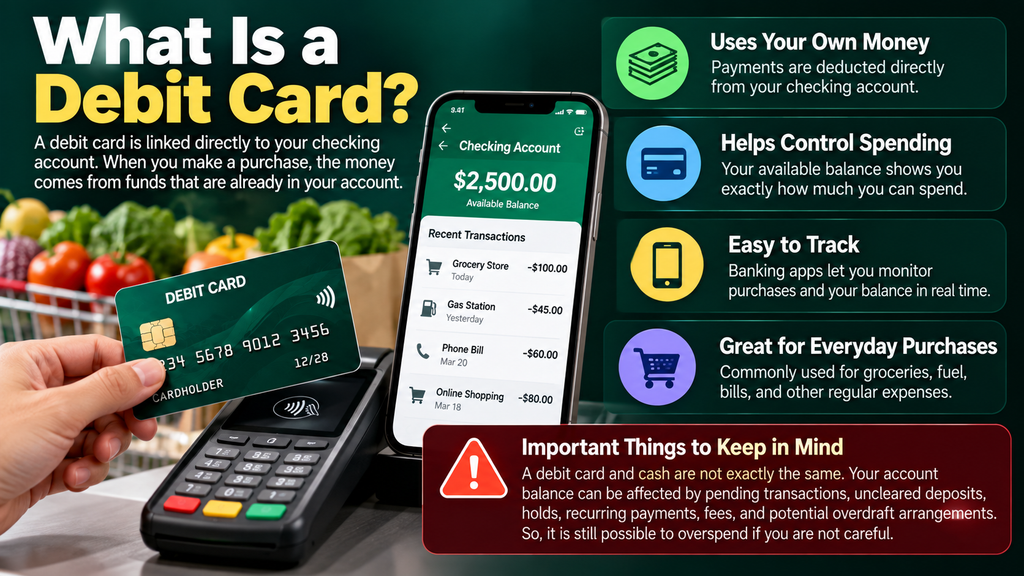
For those who wish to keep their spending closely tied to their actual available funds, this feature of debit cards is quite appealing. If you have ever been tempted to view a credit card’s spending limit as ‘disposable income,’ a debit card can establish a clear and visible boundary for your expenses. Through banking apps, you can easily track the impact of purchases on your account, making the process of budgeting or monitoring expenses feel much more direct and immediate.
However, a debit transaction and cash are not the same thing. Your account balance can be affected by pending transactions, uncleared deposits, holds, recurring payments, fees, and potential overdraft arrangements. Therefore, you must monitor your account carefully. When considering credit card vs. debit card, “debit means I can never overspend” is therefore too simplistic.
How a Debit Card Works
Suppose David has $2,000 in his checking account and uses his debit card to purchase groceries worth $150. His bank approves the transaction, and the purchase amount is ultimately deducted from that account. He does not receive a monthly credit card bill for the $150 because he did not borrow the money through a credit card account.
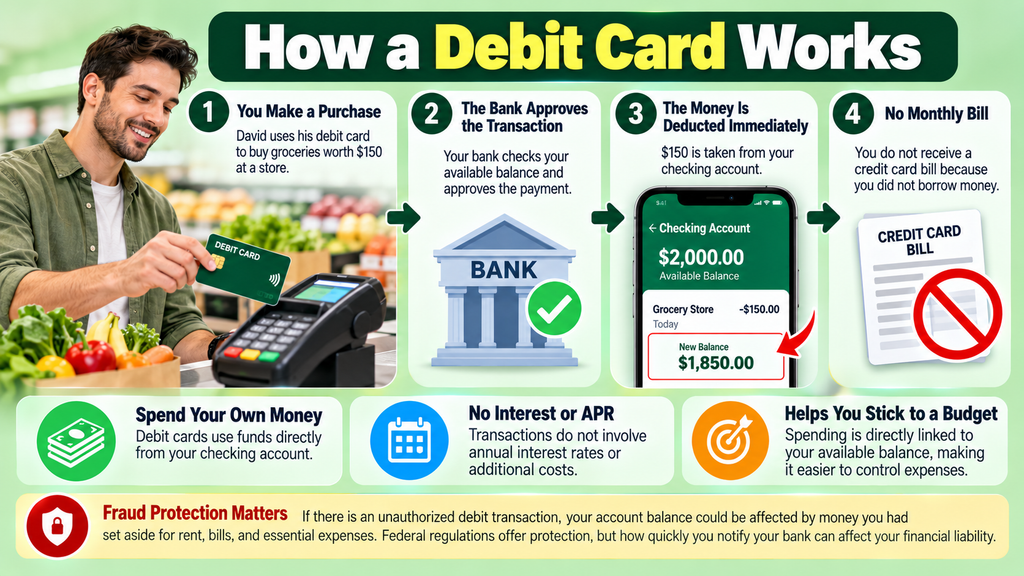
This direct link between spending and cash is the primary appeal of a debit card. With a debit card, there is no need to remember to pay for purchases later. Furthermore, unlike credit cards, these transactions do not involve annual interest rates (APR) or additional costs. This simplicity can be highly beneficial for those who wish to strictly adhere to a monthly budget.
This issue—or the trade-off involved—becomes even more apparent when a problem arises. If funds are withdrawn from your checking account via an unauthorized debit transaction, the disputed amount might involve money originally set aside for rent, utility bills, and essential purchases. Although federal regulations offer protection, your financial liability regarding a debit card depends largely on how quickly you notify the authorities about the card’s loss or theft, or about the unauthorized transaction. “Consumer Financial Protection Bureau.” That makes fraud protection an essential part of a credit card vs. debit card comparison.
4. Credit Card vs. Debit Card: Quick Comparison
Here is a simple summary of the key differences. Specific terms and benefits depend on your bank, credit union, card issuer, payment network, account agreement, and the specific card.
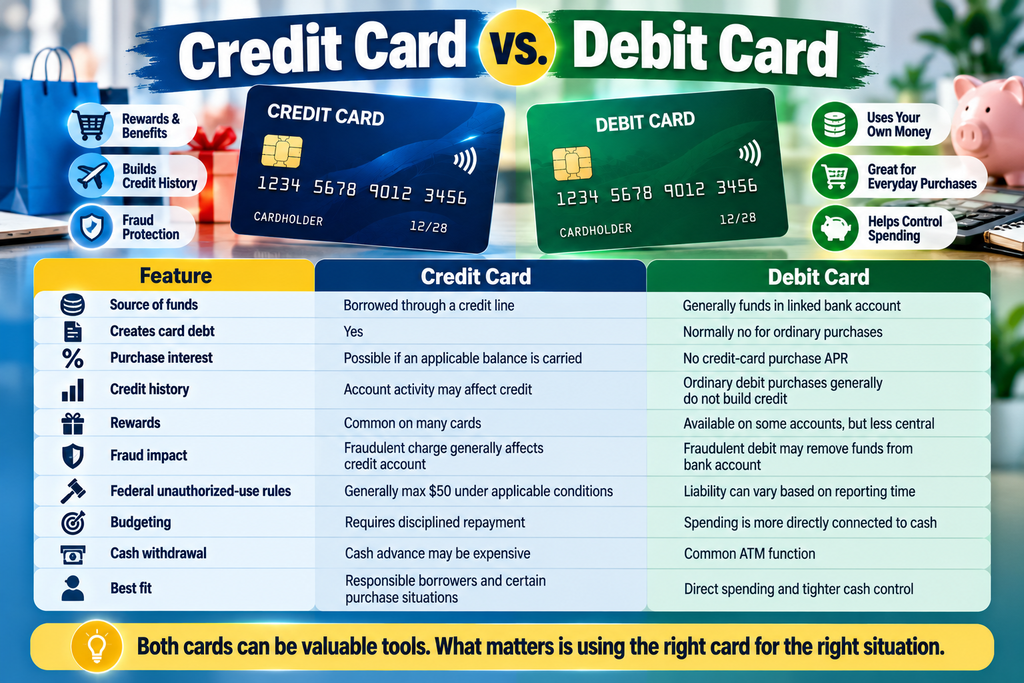
| Feature | Credit Card | Debit Card |
| Source of funds | Borrowed through a credit line | Generally funds in linked bank account |
| Creates card debt | Yes | Normally no for ordinary purchases |
| Purchase interest | Possible if an applicable balance is carried | No credit-card purchase APR |
| Credit history | Account activity may affect credit | Ordinary debit purchases generally do not build credit |
| Rewards | Common on many cards | Available on some accounts, but less central |
| Fraud impact | Fraudulent charge generally affects credit account | Fraudulent debit may remove funds from bank account |
| Federal unauthorized-use rules | Generally max $50 under applicable conditions | Liability can vary based on reporting time |
| Budgeting | Requires disciplined repayment | Spending is more directly connected to cash |
| Cash withdrawal | Cash advance may be expensive | Common ATM function |
| Best fit | Responsible borrowers and certain purchase situations | Direct spending and tighter cash control |
The table makes the credit card vs. debit card distinction look simple, but your behavior matters enormously. A rewards credit card that offers certain benefits or value but saddles you with high-interest debt could ultimately prove detrimental. Similarly, opting for debit cards to avoid the risk of debt does not mean you can afford to neglect fraud alerts or monitor your account balance.
Think of these cards as two financial tools from the same toolbox. A hammer isn’t necessarily ‘better’ than a screwdriver in every situation. What matters is whether you are using the right tool correctly.
5. Where the Money Comes From
The clearest difference between a credit card vs. debit card is the source of the money. A debit card typically offers the electronic facility to use your own funds held in a linked account. On the other hand, a credit card allows you to utilize credit or a loan from the card-issuing institution—subject to a set limit and the terms of the account.
Suppose you have $4,000 in your checking account and a credit card limit of $10,000. If you purchase a $500 airline ticket using a debit card, the transaction ultimately reduces the balance in your bank account. However, if you buy the same ticket with a credit card, the cost is not deducted from your bank account; instead, it becomes part of the outstanding debt you owe to the credit card issuer.

This distinction becomes particularly important when you are on a limited budget. If $500 leaves your checking account today, you will have $500 less cash on hand for upcoming expenses. A credit card might preserve the immediate availability of cash in your checking account, but it does not eliminate the obligation to pay that $500; you are simply altering the timing and method of payment for the purchase.
This can create a psychological trap. Seeing $4,000 in your checking account after making a credit card purchase might lead you to believe that you still have the full $4,000 available for other expenses. However, from a financial perspective, a portion of that money may need to be set aside to pay the upcoming credit card bill. A good habit is to treat every credit card purchase as if the money has already left your budget, even though, in reality, it may not yet have been deducted from your checking account.
6. Credit Building and Your Credit History
Another major credit card vs. debit card difference is the relationship with your credit history. A credit card is a type of loan or credit account. Information regarding its usage can become part of your credit report and may influence your credit score, depending on the specific scoring model and the data in the report. In contrast, purchases made with a debit card typically utilize funds you already possess; this does not create a traditional ‘revolving credit account’ (an account that allows for borrowing and reusing funds).
This matter is significant for many consumers in the United States, as credit-related information plays a crucial role when obtaining mortgages, auto loans, and other forms of credit. However, simply using a credit card does not guarantee a high credit score; rather, how you manage the account is what truly matters. Failure to pay installments or bills on time, accumulating excessive debt, or engaging in irregularities regarding credit management can all hinder the development of a strong credit record.

Consider two young men who have just graduated from college. One uses only a debit card. The other obtains a credit card, makes planned purchases each month, keeps his spending under control, and makes regular payments according to the stipulated terms. While their transaction patterns at the point of purchase or payment counter might appear identical, only the second individual is using that credit account to build a formal, documented history of borrowing.
This does not mean you have to spend money solely to build a credit score or establish credit. Instead, you can use the card to cover the everyday expenses you would have incurred anyway and manage the account prudently. When evaluating credit card vs. debit card, this credit-building function is a genuine structural difference, but it should never become an excuse to buy things you cannot afford.
7. Fraud Protection and Unauthorized Transactions
Fraud is where the credit card vs. debit card discussion becomes especially important because U.S. federal rules do not treat every situation identically. Both types of payments have security measures in place, and individual issuing institutions may voluntarily provide protections that exceed the federal minimum. Nevertheless, the rules regarding statutory liability and the impact on actual cash flow differ.
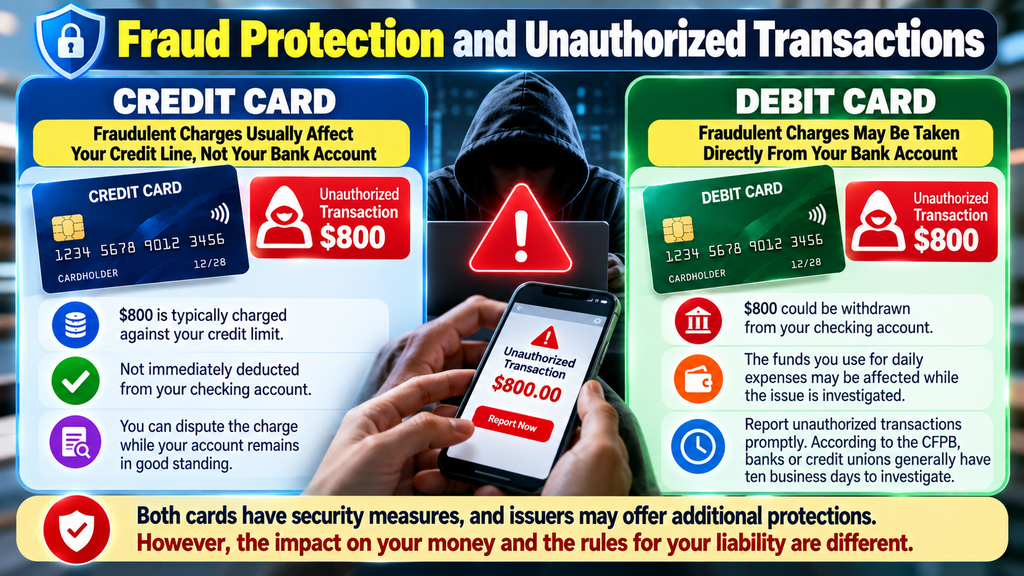
The key practical difference is easy to understand. If someone fraudulently spends $800 using a credit card, the disputed amount is typically charged against your credit line; in other words, $800 is not immediately deducted from your checking account. On the other hand, if an unauthorized transaction of $800 is made using a debit card, the funds could be withdrawn from the account you use for daily expenses while the matter is still under investigation.
This does not mean that there are no security measures for debit cards; on the contrary, such measures certainly exist. The key point is that it is crucial to report unauthorized transactions promptly. According to the Consumer Financial Protection Bureau (CFPB), once notified of an unauthorized electronic transaction, banks or credit unions generally have ten business days to investigate the matter, subject to applicable regulations and circumstances.
Credit Card Fraud Protection
Subject to applicable terms and conditions, under federal law, a cardholder’s liability for unauthorized credit card use is generally limited to the lesser of $50 or the amount of the unauthorized charges incurred prior to notifying the card issuer. If you report the loss or theft of the card before any unauthorized use occurs, you cannot be held liable for such unauthorized charges. Even if you still possess the card but only your account number is stolen, the CFPB (Consumer Financial Protection Bureau) states that you generally bear no liability for the unauthorized use.
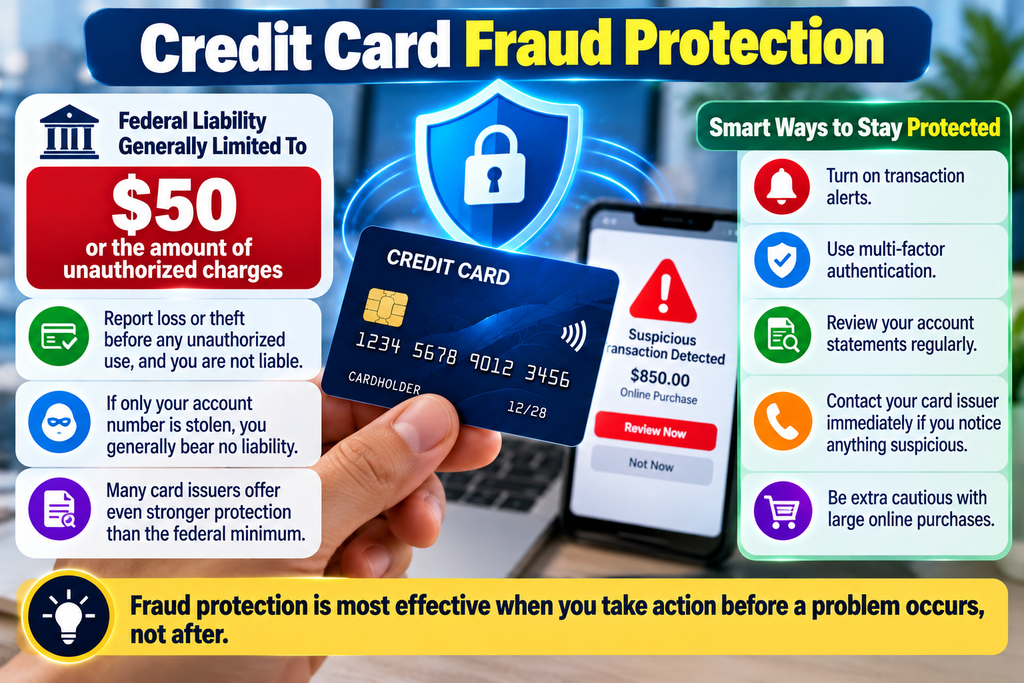
Many card issuers offer benefits that go beyond the legally mandated minimum protections, so it is advisable to review your cardholder agreement. However, do not let the presence of robust fraud-prevention measures make you complacent. Enable transaction alerts, use multi-factor authentication wherever possible, regularly check your account statements, and contact your card issuer immediately if anything seems suspicious.
When making large online purchases or facing concerns about the compromise of card details, these features can make a credit card attractive. The broader lesson from the credit card vs. debit card comparison is that fraud protection should be considered before a problem occurs, not after.
Debit Card Fraud Protection
Federal protections apply to debit cards as well, but it is important to pay close attention to the rules regarding timeframes. According to the FTC, if you report your debit card lost or stolen before any unauthorized transaction occurs, you will not be held liable for any charges (i.e., your liability is $0). If unauthorized use does occur and you report it within two business days of discovering it, your maximum liability is generally $50. If you take longer than two business days but report the issue within 60 calendar days of the statement date, your potential liability could increase to $500. If this 60-day window expires, federal regulations say you could face further financial loss from subsequent unauthorized transactions.
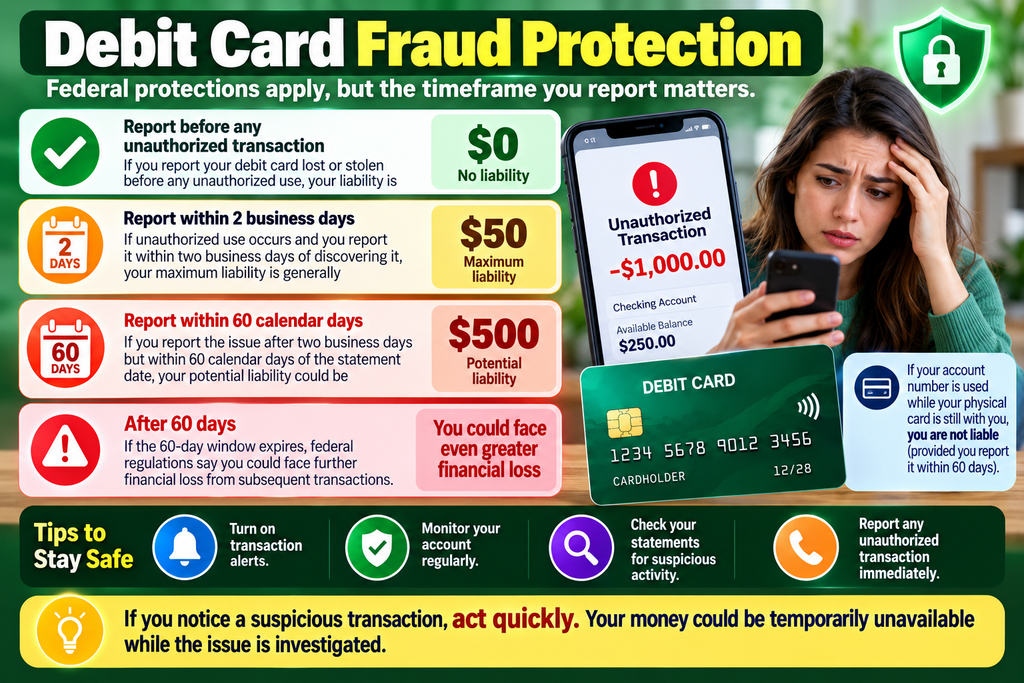
There is a significant distinction regarding whether or not the physical debit card is lost or stolen. According to the FTC, if your account number is used while the card remains in your possession, you are not liable for any unauthorized transactions—provided you report the matter within 60 calendar days of the account statement being sent.
Imagine that $1,000 has been fraudulently withdrawn from your checking account—money you had set aside for next week’s rent. While you might eventually secure protection and resolve the issue, the temporary inability to access those funds can create significant anxiety or stress regarding your cash flow. Precisely for this reason, it is crucial to monitor your debit account and take immediate action the moment you notice any suspicious transaction.
8. Interest, Fees, and the Real Cost of Spending
When comparing credit card vs. debit card, the purchase price is only part of the story. Generally, you do not have to pay interest when shopping with a debit card, as you are not borrowing funds through a credit card account. However, the situation is different with credit cards; if you leave a portion of the outstanding balance unpaid—contrary to the card’s terms—the cost of an item purchased yesterday could end up being higher for you tomorrow due to accrued interest.
Suppose you purchase a refrigerator worth $1,500 using a credit card. If your card offers a grace period, you qualify for it, and you pay the full bill by the due date, you can avoid paying interest on that purchase. The CFPB explains that while most credit cards offer a grace period for purchases, such periods are not legally required for transactions like cash advances and generally do not operate in the same way. The Consumer Financial Protection Bureau notes, however, that if you carry over (revolve) the purchase balance, interest may accrue in accordance with the card agreement.
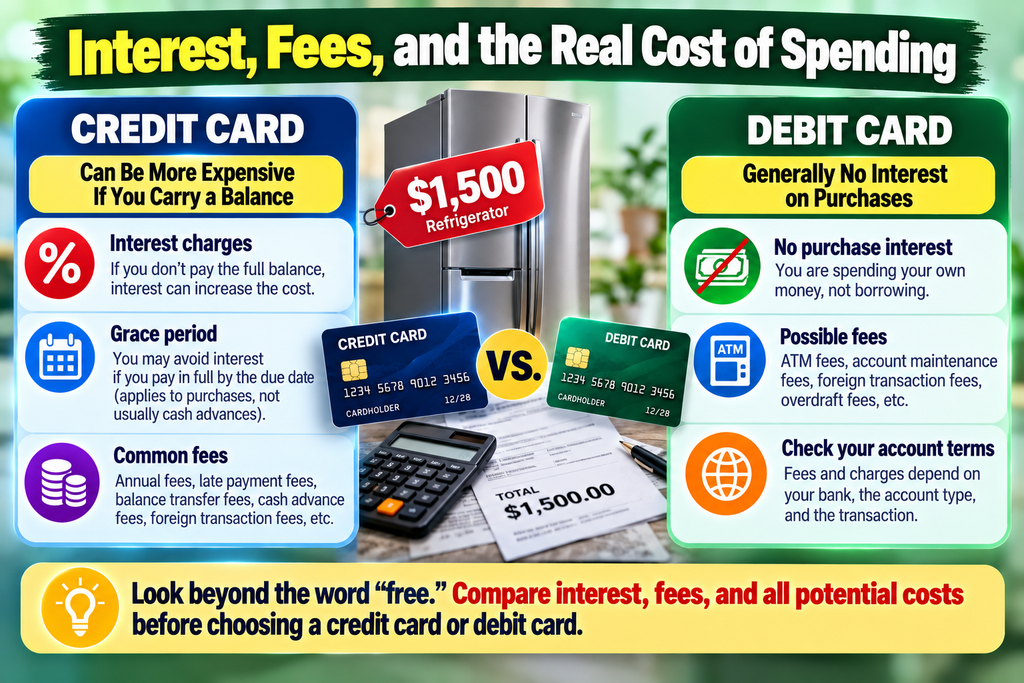
While using a debit card allows one to avoid the specific costs associated with borrowing, it does not mean there are no fees or charges involved. Depending on the account and the nature of transactions, customers may incur ATM fees, account maintenance charges, foreign transaction costs, or overdraft fees. Similarly, for credit cards, charges such as annual fees, late payment fees, balance transfer fees, cash advance fees, foreign transaction fees, and other levies may apply, depending on the card type.
So a responsible credit card vs. debit card cost comparison requires looking beyond the word “free.” Review the terms and conditions of your account. There can be significant differences in the financial mechanics between a no-annual-fee credit card where the balance is paid off in full and a premium rewards card with a high annual fee or a card that carries a revolving balance.
9. Rewards, Cash Back, and Other Benefits
One of the reasons many Americans prefer using credit cards for everyday purchases is the various benefits or ‘rewards’ they offer. Depending on the card type, these benefits can include cash-back, reward points, airline miles, hotel rewards, sign-up bonuses, or special shopping perks. For instance, if someone spends $1,000 on planned purchases and receives 2% cash-back, they would earn $20 in rewards, subject to meeting the applicable conditions.
However, the concept of rewards can often turn into a deceptive lure. If you end up spending $200 on unnecessary items just to get $20 in cash-back, you haven’t actually gained anything in the end. Similarly, the interest charged on an outstanding or “carried balance” can quickly wipe out the financial benefits gained from standard rewards. A good rule for evaluating credit card vs. debit card rewards is to ignore the points until you have first answered a more important question: Would I have made this purchase in the end, and will I be able to pay the credit card bill according to plan?

While some financial institutions offer reward benefits on debit cards as well, the rewards system is traditionally a key feature of the US credit card market. The actual value or benefit of these rewards can vary widely; even cards offering attractive perks may come with additional fees or complex rules regarding reward redemption.
Consider rewards merely as a ‘garnish’ rather than the main course. Controlling expenses, the ability to repay debt, account fees, fraud protection, and your overall financial plan are far more important. If the allure of rewards leads to overspending, using a standard debit card—even without accumulating a large number of ‘points’—may prove more financially beneficial.
10. Credit Card vs. Debit Card for Everyday Purchases
What about the purchases Americans actually make every week? For groceries, gas, restaurant meals, subscriptions, online orders, and household expenses, any card might do the job. The best practical choice depends partly on whether you can manage credit without accumulating a burden of unnecessary debt.
Suppose you spend $600 a month on groceries. If you have budgeted for this amount and consistently pay off your credit card balance in full, using a suitable “rewards credit card” allows you to enjoy extra benefits while retaining the card’s security features. However, if using a credit card causes your spending to rise from $600 to $850—simply because the expense does not feel directly linked to your bank balance—then using a debit card might help you maintain better control over your spending.
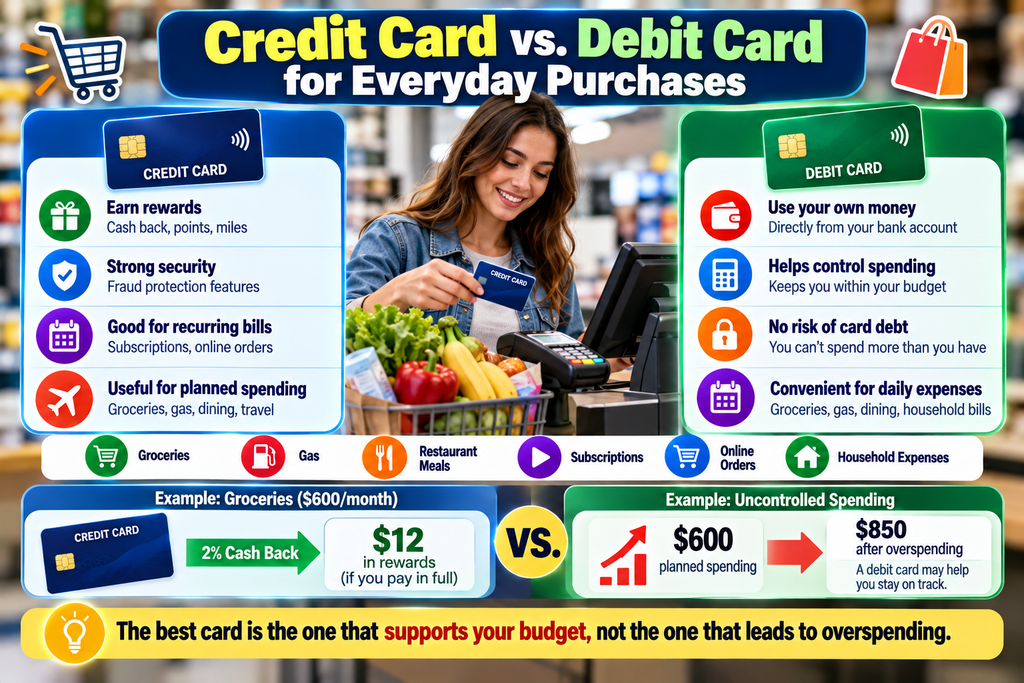
With recurring subscriptions, a credit card can separate merchant billing from your cash deposit account, yet you still need to monitor charges and keep payment information up to date. In the case of a debit card, subscription fees are deducted directly from your checking account balance; consequently, an unexpected renewal could impact the cash available for paying other bills.
There is no magical payment method that can fix bad spending habits. The strongest credit card vs. debit card strategy is the one that supports your budget rather than quietly undermining it.
Online Shopping, Gas, Hotels, and Travel
Fraud is a critical concern in online shopping, as it involves the use of your card details from a remote location. According to Federal Reserve data, 23 percent of consumer purchases and person-to-person money transfers in 2024 were conducted remotely or online—a rate that has been rising annually since 2021. Additionally, in 2024, consumers made an average of 11 payments per month using their mobile phones.
Hotels and car rental agencies may also place an ‘authorization hold’ (a temporary block on funds) on your card. For debit cards, this can temporarily reduce the balance in your bank account, while for credit cards, it may lower your available credit limit. Since policies vary among different companies, travelers should not assume that all payment methods work the same way; instead, they should check the terms and conditions of the specific hotel or car rental agency before arriving at their destination.
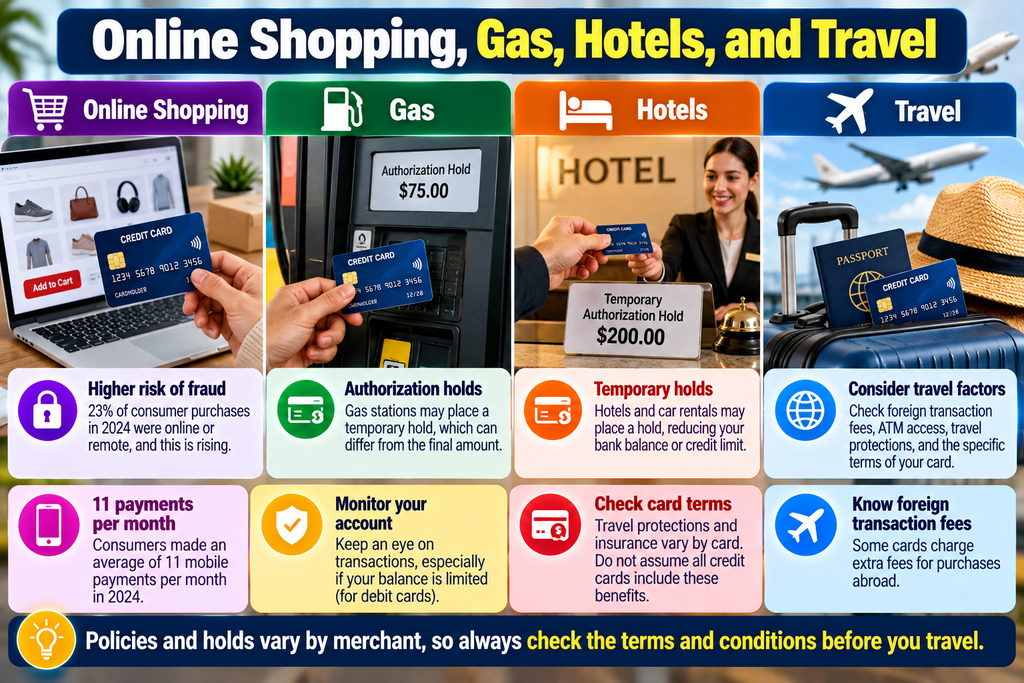
The amount of temporary authorization at gas stations, restaurants, and other commercial establishments may differ from the final transaction amount. If your checking account has a very limited balance, this is another reason to monitor your debit card transactions carefully.
For travel, the credit card vs. debit card decision should also consider foreign transaction fees, ATM access, travel protections, rental-car policies, and the exact terms of your individual card. Do not assume that a card automatically comes with insurance or travel protection benefits simply because it is a credit card; the features and benefits vary significantly from one card to another.
11. Which Card Should You Use?
The practical answer to credit card vs. debit card is that the right payment method depends on the transaction and, just as importantly, on your financial behavior. Credit cards offer flexibility in borrowing, opportunities to build a credit score, various rewards, and essential security benefits. On the other hand, debit cards connect directly to your available funds, eliminating the risk of accumulating outstanding debt—such as a revolving balance—associated with everyday purchases.
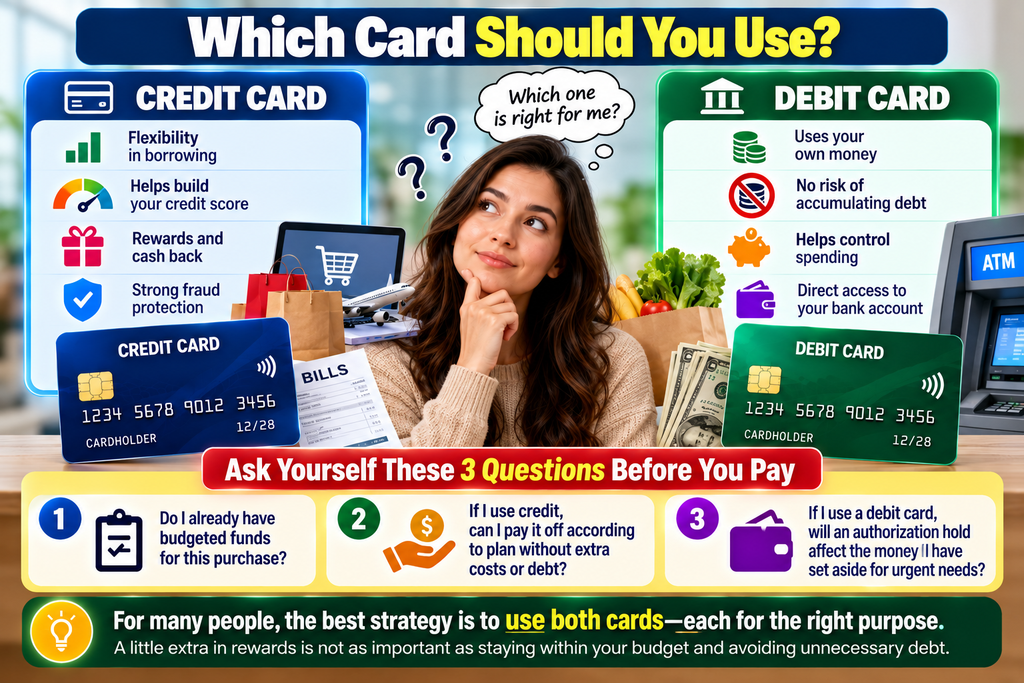
For many families, using a combination of both cards—rather than selecting just one as the single best option—can be the most effective strategy. One might use a credit card for planned online purchases and regular bill payments while paying off the balance in full, yet opt for a debit card when withdrawing cash from ATMs or spending directly from the bank account to maintain control over expenses. Conversely, those striving to avoid accumulating credit card debt might consciously prioritize using a debit card.
Asking yourself three questions before making a payment makes the decision easier: Do I already have budgeted funds for this purchase? If I use credit, can I pay it off according to plan without incurring an extra financial burden or accumulating debt? And regarding debit card usage—if funds get tied up due to a transaction or an ‘authorization hold,’ will it impact the money I have set aside for urgent or immediate needs?
A particular card might offer an extra one percent in rewards—but your answers are even more important than that.
When a Credit Card Can Make Sense
Using a credit card can be particularly advantageous if one maintains strict spending discipline and has a reliable system for settling bills. It can also be useful for building a responsible credit history and earning rewards or benefits on specific online purchases, travel bookings, or everyday expenses. However, the most crucial condition is that access to credit should never be viewed as a license to unnecessarily inflate one’s lifestyle or indulge in extravagance.
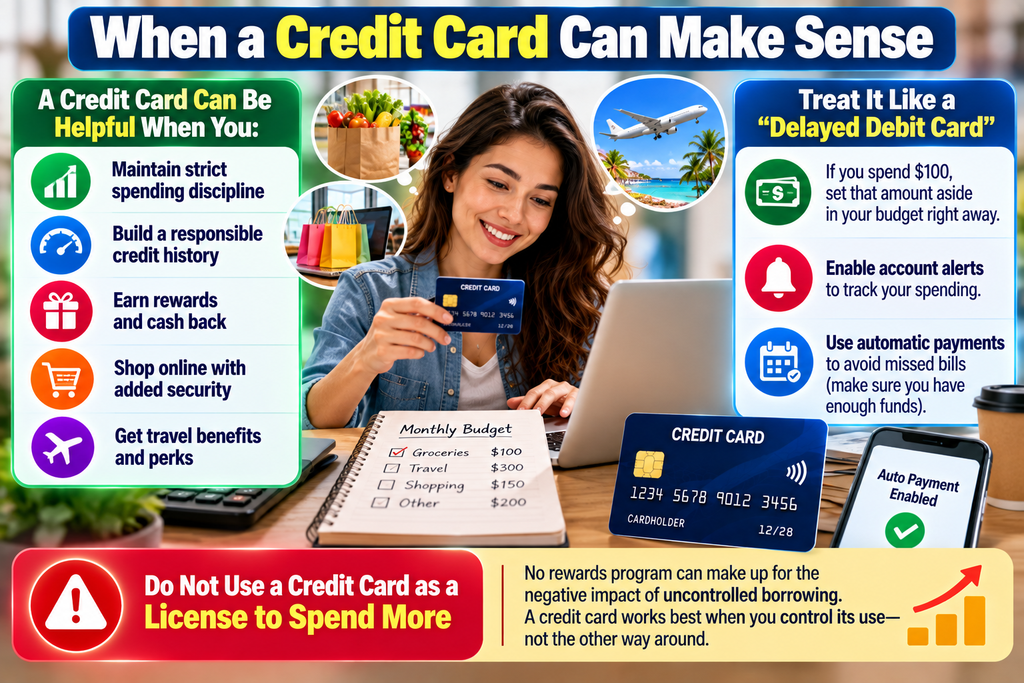
One effective strategy is to view a credit card as a form of ‘delayed debit card.’ For instance, if you spend $100 on groceries, make a mental note to immediately set aside or deduct that amount from your spending budget; do not wait for the billing statement to arrive before deciding how to cover the expense. Enabling account alerts and automatic bill payments can help minimize the risk of significant financial loss due to minor oversights; however, you must ensure that sufficient funds are available in the account when the automatic payment is processed.
The biggest danger in the credit card vs. debit card comparison is focusing exclusively on card features while ignoring behavior. No fantastic rewards program can compensate for the downsides of uncontrolled borrowing. A credit card is most effective when you control its usage yourself—ensuring that the credit limit does not dictate your spending.
When a Debit Card Can Make Sense
Using a debit card can be a sensible choice when you want your purchases directly linked to the cash you have on hand. It is particularly beneficial for ATM withdrawals and for customers prone to overspending due to ‘revolving credit’ or borrowing facilities. Seeing the remaining balance in your checking account decrease after a purchase provides a clear sense of your spending.
Suppose you set aside $400 for discretionary spending this month. Using a debit card for purchases can make it easier to keep track of this spending limit. As a result, your expenses do not carry over to the next month’s credit card bill, and you avoid paying interest on any outstanding credit card balance or ‘revolving balance’.
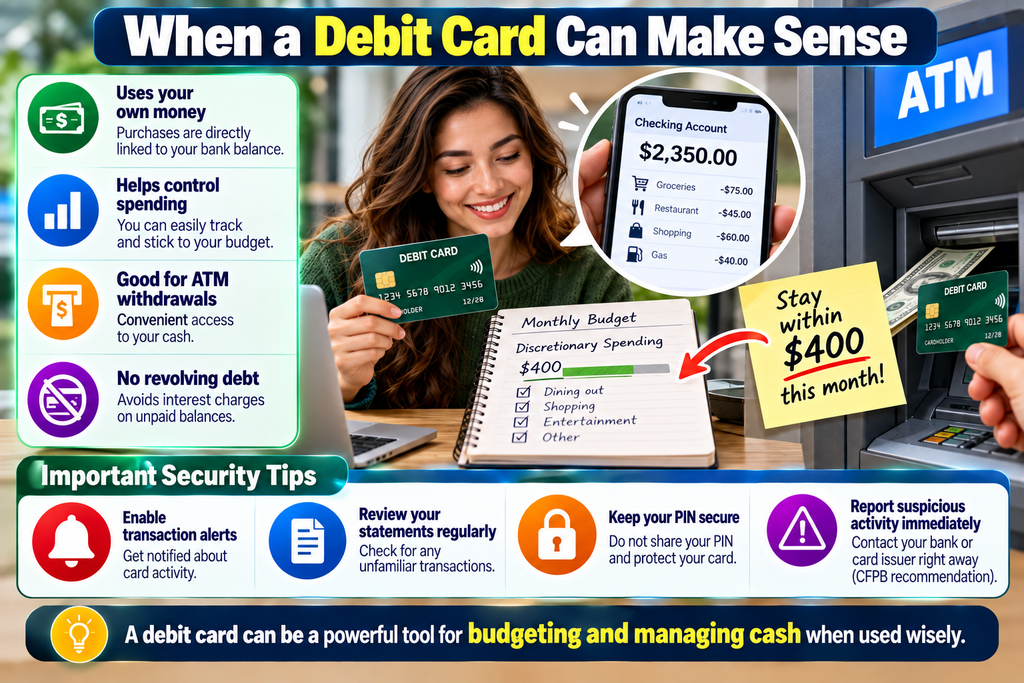
One drawback is that you must carefully safeguard the linked account. Keep transaction notifications enabled if your financial institution offers them, regularly review account statements, keep your PIN secure, and report any suspicious activity immediately. The CFPB strongly advises contacting your bank or card issuer promptly if you notice any suspicious transactions.
Ultimately, credit card vs. debit card is not a contest where one side must win every round. A debit card can be an effective means of budgeting and managing cash; on the other hand, if used prudently, a credit card can serve as a valuable tool for making payments and building a credit score.
Conclusion: Credit Card vs. Debit Card
The credit card vs. debit card difference starts with one simple fact: Generally, a debit card is used to spend funds from a linked bank account, whereas a credit card allows you to borrow against an established credit limit. This fundamental difference gives rise to almost all other aspects—such as interest, repayment obligations, credit reporting, rewards, fraud-related procedures, and the impact on cash flow.
If you follow the rules, stick to your shopping budget, and pay off your credit card balance in full as planned, you can enjoy the various benefits of a credit card without incurring any extra interest. However, if using a credit card tempts you to spend beyond your means or saddles you with a heavy interest burden, a debit card can establish a more direct and tangible link between your purchases and your actual funds. That said, keep in mind that no card eliminates the negative consequences of overspending.
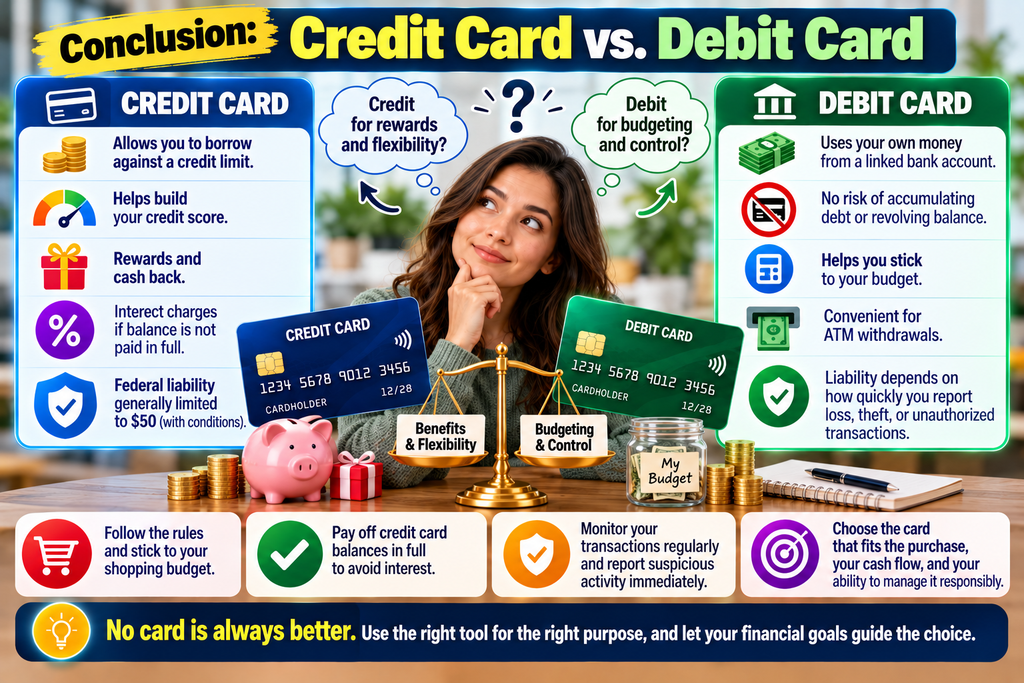
Security is of paramount importance in both cases. Subject to certain conditions, federal law generally limits a customer’s financial liability for unauthorized credit card use to $50; conversely, liability for debit cards largely depends on how quickly the loss or theft of the card—or the unauthorized transaction—is reported. The FTC advises that, regardless of the card you use, you should regularly monitor your transactions and take prompt action if you notice any irregularities.
The most useful way to settle credit card vs. debit card is therefore not to ask, “Which card is always better?” Ask, “Which tool fits this purchase, my cash flow, and my ability to manage it responsibly?” That question turns two similar-looking pieces of plastic into deliberate financial tools.
FAQs About Credit Card vs. Debit Card
1. What is the main difference between a credit card and a debit card?
The central credit card vs. debit card difference is where the purchase money comes from. A debit card typically draws funds from the linked checking account. In contrast, a credit card generally utilizes a line of credit provided by the issuer; essentially, transactions made with it become an outstanding debt. This distinction impacts debt repayment, interest, cash flow, and credit history. While the two cards may appear similar in physical form and usage at the time of purchase, the underlying financial mechanisms governing their operation are entirely different.
2. Is a credit card safer than a debit card for fraud?
Federal protections exist for both, though the rules differ. Under applicable federal law, liability for unauthorized credit card use is generally capped at $50; furthermore, if you retain possession of the card and only the account number is stolen, you typically bear no liability. For debit cards, liability depends on how quickly you report the loss, theft, or unauthorized transaction to the authorities. According to the FTC, there is also a practical difference regarding cash flow: an unauthorized debit transaction can result in actual funds being deducted from your account before the issue is resolved.
3. Does using a debit card build credit?
Generally, making purchases with a debit card does not build a traditional credit history, as you are spending funds from your own deposit account rather than borrowing through a credit account. In contrast, a credit card is a type of ‘revolving credit account’—allowing for repeated borrowing and repayment within a set limit—and its usage can contribute to building your credit history. However, simply possessing a credit card does not guarantee a good credit score or creditworthiness. Responsible account management is crucial; therefore, customers should never incur unnecessary debt solely for the sake of generating transaction activity on the card.
4. Can I avoid paying interest when using a credit card?
Yes, it is possible. According to the CFPB, most credit cards offer a ‘grace period’ for purchases, although card issuers are not legally required to provide one. If your account includes this feature and you pay the outstanding balance in full by the due date, you generally do not have to pay interest on those purchases. The Consumer Financial Protection Bureau (CFPB) notes that different rules may apply to cash advances and other types of transactions; therefore, you should always review your card agreement.
5. Should I have both a credit card and a debit card?
Many customers use both cards because they serve different purposes. A debit card allows access to funds in a checking account and is highly convenient for withdrawing cash from ATMs or making direct purchases. On the other hand, a credit card offers benefits such as the ability to make purchases on credit, various rewards, advantages for one’s credit history, and protection against fraud. The best credit card vs. debit card arrangement depends on your spending habits, income stability, ability to repay debt, account fees, and financial goals. The important part is understanding what happens every time you choose one card over the other.