
Learning how to manage your money is not about becoming wealthy overnight, giving up everything you enjoy, or building a complicated spreadsheet that requires an accounting degree to understand. Essentially, financial management means deciding where your money will go before your daily life makes that decision for you. Your income faces competing demands: rent or loan installments, groceries, commuting costs, insurance premiums, debt repayment, retirement savings, entertainment, and emergency funds. Without a concrete plan, even a good income can vanish surprisingly fast. However, by following a realistic approach, it is possible to meet current needs while also achieving future goals using that same income.
Table of Contents
The matter becomes even more significant when examining the actual spending of U.S. households. According to data from the U.S. Bureau of Labor Statistics, the average annual expenditure for a household—or “consumer unit”—in 2024 was $78,535, amounting to approximately $6,545 per month. Of this total, average annual spending was $26,266 on housing and $13,318 on transportation; combined, these two categories accounted for more than half of the average household expenditure. Additionally, the average expenditure on food was $10,169. It is important to note that these figures represent national averages rather than specific targets for your own budget; nevertheless, they highlight a crucial aspect of financial management: making well-considered decisions regarding a few major expenses while simultaneously ensuring that remaining funds do not quietly slip away through numerous small, incidental costs.

So, how do you manage your money successfully? You need a disciplined and consistent approach that can be followed repeatedly—not just a few isolated money-saving tactics. The ten steps outlined below will help you understand your cash flow, control expenses, save regularly, manage debt, prepare for emergencies, and gradually build wealth. There is no requirement to implement all ten steps by this weekend; start with the first step, build the habit, and then gradually move on to the subsequent steps.
Why Learning How to Manage Your Money Matters
Knowing how to manage your money gives you something easy to underestimate: financial breathing room. Consider two employees with roughly equal salaries. The first spends without keeping track, carries outstanding debt on multiple credit cards, maintains no emergency savings, and only considers how to pay bills after receiving them. In contrast, the second person knows the approximate amount needed for monthly expenses; they automatically save a portion of their salary immediately upon receipt, keep unnecessary or discretionary spending within set limits, and regularly review their financial goals. Although their incomes are nearly identical, their experiences regarding their financial situations can be vastly different. While financial management cannot magically eliminate every financial crisis, it can make the impact of unexpected events much more manageable.

Recent data from the Federal Reserve highlights why this additional financial safeguard—or “cushion”—is so crucial. In a report based on the financial status of households in 2025, the Federal Reserve noted that 63 percent of adults could cover a hypothetical emergency expense of $400 using cash or its equivalent—a figure that has remained unchanged over the past three years. The report further indicated that 59 percent of adults had faced at least one major unexpected expense in the preceding 12 months. Major car repairs or replacements were the most common issue, affecting 30 percent of individuals. These statistics transform the concept of “emergency savings” from a mere abstract financial notion into a highly tangible and essential necessity. Cars can break down, household appliances can fail, unexpected costs—such as medical expenses—can arise, and income levels can fluctuate.
Understanding how to manage your money therefore means balancing today and tomorrow. You also need to make room in your budget for vacations, dining out, pursuing hobbies, streaming service subscriptions, and the occasional non-essential purchase that simply brings you joy. A sustainable financial plan is not a form of punishment; its primary goal is to allow you to enjoy your money while ensuring that current spending does not constantly deplete your future wealth.
1. Know Exactly Where Your Money Goes
The first rule of how to manage your money is remarkably simple: you cannot manage money you are not watching. Many people are aware of their salary and major expenses, yet they have a vague idea of where the rest of their income actually goes. Expenses like $1,600 for rent, $450 for car installments, and $180 for insurance are easily remembered. However, what often goes unnoticed are the countless small expenses—such as coffee, delivery charges, app subscriptions, miscellaneous store purchases, online shopping, restaurant lunches, ride-sharing, and impulse buys. Viewed individually, each expense might seem insignificant, but collectively, they can add up to hundreds of dollars in monthly spending.

Start by calculating your actual monthly income—that is, the money you have in hand after taxes and other deductions—rather than basing your calculations solely on your gross annual salary. For instance, an annual income of $70,000 does not mean you have $5,833 available to spend each month; taxes, insurance premiums, retirement fund contributions, and other payroll deductions can reduce the amount actually deposited into your bank account. Next, review your checking account and credit card transactions from at least the past one to three months. Categorize your expenses into groups such as housing, utilities, transportation, groceries, dining out, insurance, debt repayments, subscriptions, shopping, entertainment, healthcare, savings, and miscellaneous expenses.
Do not judge yourself while doing this. The goal is to assess the situation, not to induce guilt. Think of your bank statement as a financial ‘X-ray.’ Suppose you spent $450 on dining out last month; this figure is neither morally good nor bad—it is simply a piece of necessary information. Once you know where your money is going, you can decide whether this spending aligns with your priorities.
Track Your Spending for 30 Days
If you genuinely want to learn how to manage your money, try tracking every purchase for 30 days. You can use budgeting apps, banking categories, spreadsheets, or even a simple notebook. Keeping a regular record is more important than the specific method you choose. Track not only regular bills and expenses but also your daily purchases. A $6 cup of coffee might seem insignificant, but when you do the math, you might find yourself spending $150 a month just on coffee and breakfast. Similarly, while four subscriptions costing $10 to $20 each might seem inexpensive individually, they can quietly add up to an annual expenditure of $600 or more.
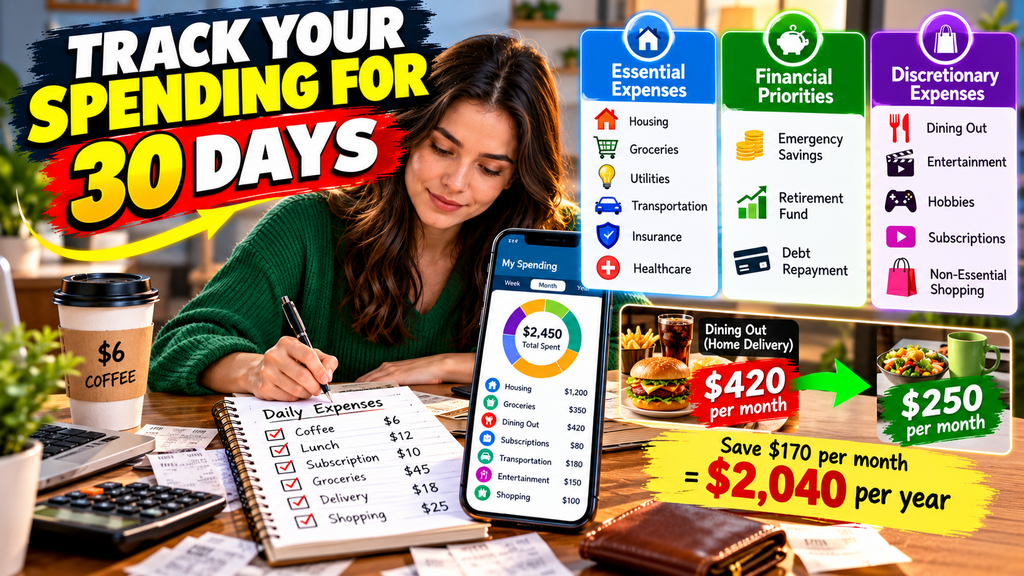
At the end of the month, categorize your expenses into three main groups: essential expenses, financial priorities, and discretionary or lifestyle expenses. Essential expenses include housing, groceries, utility bills (such as electricity, gas, and water), transportation, insurance, and necessary healthcare. Financial priorities may include saving for emergencies, contributing to a retirement fund, and debt repayment. Discretionary expenses cover dining out, entertainment, hobbies, optional subscriptions, and non-essential purchases. The boundaries between these expense categories may vary from family to family, and that is perfectly fine.
Instead of imposing strict controls on every single purchase, observe your spending patterns. Suppose you notice that you spent $420 on dining out or home delivery in a single month. This does not mean you have to eliminate this expense. By reducing it to $250, you could save $170 a month—amounting to $2,040 annually. This is where the true power of money management lies: rather than making a vague resolution to “spend less,” you are making a specific and measurable decision.
2. Create a Realistic Monthly Budget
Once you understand your spending, the next step in how to manage your money is creating a budget that reflects your actual life. A budget should not be like a prison cell, but rather like a GPS. Just as a GPS tells you where you are, where you want to go, and the route to get there—without ever faulting you for stopping for a coffee along the way—an effective budget similarly determines how your income is spent while maintaining some flexibility for the normal needs of daily life.
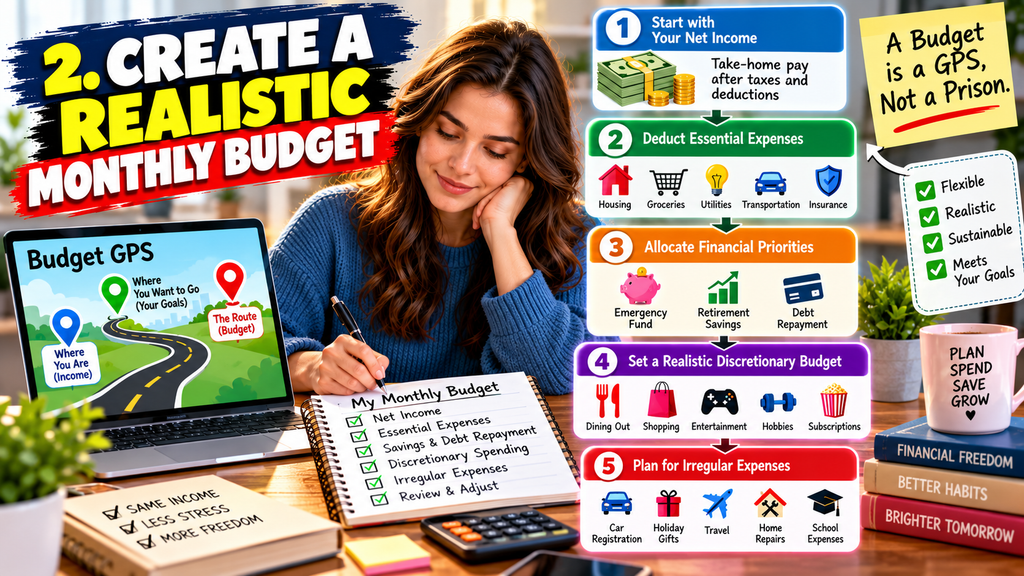
Start with your monthly net income (take-home pay) and deduct essential expenses. Next, allocate funds to financial priorities such as building an emergency fund, saving for retirement, and paying off debt. Finally, set a realistic budget for discretionary spending. If you currently spend $700 a month on dining out, allocating only $50 in your budget might look appealing on paper, but it is unlikely to be sustainable in reality. Instead, gradually reducing your spending—first to $500 and then to $400—would be a far more sustainable approach.
Your budget should also account for irregular expenses. Items such as car registration, festive gifts, annual insurance premiums, school expenses, vacations, and home repairs may not occur every month, yet they are not unexpected events either. If you plan to spend $1,200 on travel and gifts during the festive season, setting aside $100 each month can make the month of December much less stressful. The Consumer Financial Protection Bureau (CFPB) offers tools and resources that assist in creating cash-flow budgets, improving cash flow, prioritizing bill payments, and formulating debt repayment plans.
Give Every Dollar a Purpose
A practical way to understand how to manage your money is to assign every dollar a job. This does not mean that every dollar must be physically moved into separate accounts. Rather, it means determining—before you start spending—which needs must be met with the income available to you. For instance, if your family’s monthly income is $5,500, you can allocate specific portions of that total amount to categories such as housing, utility bills, groceries, transportation, insurance, minimum debt payments, additional debt repayment, savings, retirement funds, entertainment, and personal expenses.
This method prevents ‘leftover money’ from turning into funds that might be spent without a specific plan. Suppose you have $700 in your bank account after paying all your bills. Without a plan, it might seem like this money is available for shopping or entertainment. In reality, however, $300 of that amount might be earmarked for next month’s car insurance, $200 for an emergency fund, and the remaining $200 for an upcoming dental bill. Therefore, simply looking at your bank balance does not reveal how much you can actually afford to spend.
To get started, you can use a well-known method like the 50/30/20 rule or a percentage-based framework, but do not treat these figures as hard-and-fast rules. Spending patterns can vary significantly between those paying high rents in cities like San Francisco or New York and those living in lower-cost areas. Ultimately, your budget needs to align with your income, location, financial obligations, and goals.
3. Build an Emergency Fund
No guide explaining how to manage your money is complete without emergency savings. An emergency fund consists of money set aside for genuine, unexpected needs—such as urgent car repairs, essential medical expenses, a temporary loss of income, or major home repairs. Without savings, even a $1,000 emergency can end up becoming outstanding credit card debt. If that balance remains unpaid and interest accumulates, a temporary problem can transform into a long-term financial burden.
A recent household survey by the Federal Reserve clearly highlights this point. The survey revealed that 63 percent of adults could cover a $400 emergency expense entirely with cash or its equivalent, whereas 12 percent stated they could not immediately meet such a cost. The key takeaway is not that everyone must instantly build a massive emergency fund; rather, it is that even a modest amount of savings can create opportunities for alternative solutions or paths forward when an unexpected situation or problem arises.
Keep the money saved for emergencies in a location or a separate account that is easily accessible, yet does not constantly tempt you to spend it. A separate savings account can be quite effective for this purpose. Before opening the account, carefully review and compare factors such as interest rates, minimum balance requirements, maintenance fees, fund transfer limits, and—where applicable—deposit insurance benefits. The primary objective of an emergency fund is not to generate massive investment returns, but rather to ensure the money is readily available when a genuine need arises.
Start Small and Build Your Financial Cushion
When learning how to manage your money, a three- or six-month emergency fund can sound overwhelming. If your essential monthly expenses amount to $4,000, your target for a three-month reserve fund would be $12,000. Facing such a large goal before you even begin saving might feel discouraging. Instead, break the goal down into smaller steps. Start by aiming to save $500, then $1,000, and subsequently an amount equal to one month’s essential expenses. Once you reach that milestone, gradually work towards building a larger reserve fund tailored to your family’s needs.
The Consumer Financial Protection Bureau recommends establishing a system for regularly depositing money into an emergency fund and identifies regular, automated transfers as one of the easiest ways to ensure consistent saving. It also advises monitoring your progress and adjusting the transfer amount if your financial situation changes.
For example, if you save $50 from each bi-weekly paycheck, you would accumulate approximately $1,300 over 26 pay periods, excluding interest. Increasing this amount to $100 per paycheck would bring the total to around $2,600. By adding funds from tax refunds, workplace bonuses, or the sale of unused items, you can grow your savings even faster without making major changes to your lifestyle.
4. Automate Your Savings
One of the easiest ways to improve how you manage your money is to stop relying entirely on willpower. If your strategy is “I will save whatever is left at the end of the month,” you will repeatedly find that nothing remains. Instead, think of savings as a bill you pay to yourself. Set up an automatic transfer immediately after receiving your paycheck, or ask your employer if they allow you to split your direct deposit between your checking and savings accounts.
The CFPB has specifically identified automated, recurring fund transfers as a simple way to make saving consistent. It further notes that employees receiving direct deposits can split their pay between their checking and savings accounts. If you receive $2,400 every two weeks and automatically deposit $120 into savings, you are setting that money aside before it gets spent on daily expenses.
It is important to monitor automated systems. Ensuring sufficient funds in your checking account is essential for money transfers and the payment of scheduled bills or dues. According to a CFPB warning, while automated payments help prevent late bill payments, a lack of adequate account balance can lead to overdrafts or additional fees due to insufficient funds. An effective system involves regular reviews alongside the automated process; therefore, do not completely lose sight of the system once it is set up.
5. Manage and Pay Down Debt Strategically
Learning how to manage your money also means understanding what you owe. Create a comprehensive list of all your debts—including credit cards, education loans, car loans, personal loans, and others—detailing the outstanding balance, interest rate, minimum installment amount, and repayment tenure for each. While viewing everything together might feel unsettling, this clarity will empower you to make informed decisions. In addition to deciding which loan to pay off with any surplus funds, ensure you continue making at least the minimum scheduled payments on all your loans.
Two common debt repayment strategies are the ‘debt avalanche’ and the ‘debt snowball.’ The ‘avalanche’ method focuses on paying off the debt with the highest interest rate using extra funds, while maintaining minimum payments on other debts; this approach can help reduce interest costs, provided you stick to it consistently. On the other hand, the ‘snowball’ method prioritizes paying off the smallest debt first, which can boost morale by creating a sense of rapid progress toward becoming debt-free. The mathematically most efficient strategy may not always be the easiest to sustain behaviorally in the long run; therefore, choose a method that you can follow regularly and consistently.
Suppose you have outstanding balances of $1,200 on one card, $4,500 on another, and $9,000 on a personal loan. Instead of making haphazard extra payments, decide which debt to prioritize and allocate your surplus funds specifically toward paying it off. Once that debt is cleared, direct the money previously earmarked for it toward your next financial goal or debt. While paying down existing debt, avoid taking on new high-interest debt as much as possible. Reducing debt and controlling expenses must work in tandem; otherwise, the effort will be as futile as trying to empty a bathtub while the tap is left running.
6. Control Your Biggest Household Expenses
People searching for how to manage your money often focus first on tiny expenses, but the largest categories deserve equal or greater attention. According to BLS data, housing and transportation accounted for 33.4 percent and 17.0 percent, respectively, of the average U.S. household expenditure in 2024; combined, these two sectors represented more than half of total spending. Additionally, 12.9 percent was spent on food. This implies that achieving significant improvements in a single major category can often be more effective than cutting costs across numerous smaller areas.
Decisions regarding housing are undoubtedly difficult to reverse quickly; therefore, one should consider the long-term implications when renewing a lease, purchasing a home, or moving. Choosing a home with monthly costs that are $250 lower—even before factoring in differences in utility or commuting expenses—can result in annual savings of $3,000. Similar attention should be paid to transportation. Before taking on a large car loan, one should look beyond the monthly installment and calculate the total cost of ownership—including financing, insurance, fuel, maintenance, registration, and depreciation.
Food is one area where even minor changes can lead to significant cost savings. According to BLS data, the average expenditure in 2024 was $6,224 for food at home and $3,945 for dining out. Steps such as meal planning, checking existing pantry stock before shopping, comparing unit prices, opting for store-brand products where appropriate, and minimizing food waste can help reduce grocery bills—without requiring you to subsist solely on simple meals like rice and beans. Ultimately, effective financial management is about bringing major, recurring expenses down to a reasonable level, not completely eliminating every small pleasure or hobby.
7. Use Credit Cards Wisely
Knowing how to manage your money requires understanding that a credit limit is not the same thing as available income. Just because your card has a credit limit of $10,000, it does not mean you can afford a $10,000 purchase. Instead, the key considerations are whether the purchase aligns with your budget and whether you can settle the resulting outstanding balance according to your repayment plan. While a credit card can be a convenient payment method, a large outstanding balance can hinder your current financial goals.
One effective strategy is to view a credit card as a type of “delayed debit card.” Before making a purchase or incurring an expense, ask yourself whether funds have already been allocated in your budget for that cost. For instance, if you spend $800 a month on groceries, fuel, and regular bills, treat that $800 as a specific portion of your budget rather than viewing the entire balance in your checking account as available for extra spending.
Set up payment reminders or automatic payments as needed, but monitor the account regularly. Check your statements for any unfamiliar transactions and ensure you have a clear understanding of the card’s APR, various fees, payment due dates, and terms and conditions. Rewards are beneficial only when they align with your regular spending habits; it is not wise to spend an extra $200 just to earn $4 in cash back. Earning rewards should be an added benefit of planned spending, not the primary reason for unnecessary expenses.
8. Save for Retirement and Long-Term Goals
The next stage of how to manage your money is making sure today’s paycheck also supports your future self. If your employer offers a workplace retirement savings or investment plan, take the time to fully understand how it works—including whether there is an employer ‘matching contribution,’ what fees or costs apply, and what investment options are available. Depending on the plan’s rules, this additional employer contribution can significantly boost the size of your retirement fund.
According to IRS data, the maximum limit for an employee’s own contribution—or ‘elective deferral’—to a 401(k), 403(b), most government 457 plans, and the federal ‘Thrift Savings Plan’ is set at $24,500 for the year 2026. For that same year, the maximum contribution limit for a standard IRA is $7,500, though eligible individuals aged 50 or older have a higher limit. Keep in mind that these are statutory maximums, not recommended savings targets for everyone. The appropriate contribution amount for you will depend on your income, age, tax situation, debt load, employer-provided benefits, and other financial goals.
Consider financial priorities beyond just retirement planning. You might be saving for a down payment on a home, a child’s college education, a new car, a wedding, travel, or starting a new business. Set specific savings amounts and timelines for your major goals. Thinking vaguely—such as “I want to buy a house someday”—makes it difficult to take concrete action. However, thinking “I want to save $30,000 for a down payment over the next five years” transforms the dream into a measurable goal (which implies saving approximately $500 per month, excluding interest or investment returns). Having a specific goal makes financial decision-making much easier, as every dollar is then tied to a tangible and defined purpose.
9. Increase Your Income Without Increasing Your Lifestyle
Most discussions of how to manage your money focus heavily on spending, but there are two sides to the equation: money going out and money coming in. There is a natural limit to cutting expenses. You might negotiate bills or curb unnecessary purchases, but fundamental needs—such as housing, food, transportation, insurance, and healthcare—remain. On the other hand, there is far greater potential to increase your income through your career.
You could consider asking for a raise based on your performance and market demand, seeking a promotion, switching jobs for better pay, acquiring in-demand skills, freelancing, working overtime, or finding legitimate ways to generate extra income. Even an additional $300 in monthly income can become quite significant if managed strategically; before accounting for taxes and business expenses, this amounts to $3,600 annually.
A major risk here is “lifestyle inflation”—where expenses rise alongside your standard of living. Suppose your monthly take-home pay increases by $500. If that entire extra amount is consumed by purchasing an expensive car, adding subscriptions, dining out frequently, or splurging on shopping, your financial situation will not improve much. Instead, consider automatically allocating a portion of your salary increase toward savings, investments, or debt repayment. You can certainly spend a part of the extra income on yourself; the goal is not to keep your standard of living stagnant forever, but to ensure that your financial health improves as your lifestyle upgrades.
10. Review Your Money Every Month
The final step in learning how to manage your money is recognizing that money management is not a one-time project. Your income fluctuates. Rent increases. Insurance premiums change. Children grow up. Cars require repairs. Goals shift. A budget that worked perfectly last January might not be effective six months later. Therefore, review your financial accounts or budget—even if only briefly—each month to ensure your financial plan remains aligned with your current reality.
During this review, compare your actual spending against the budget, track your savings progress, account for upcoming irregular expenses, check your debt levels, and verify that automated transactions (such as auto-pay or recurring payments) are still appropriate. Look out for any unusual charges or subscriptions you no longer use. If spending in a specific category exceeds the budget, do not simply scrap the entire plan. Try to understand why this happened and decide whether the budget needs adjustment or if you need to alter your spending habits.
For instance, suppose your grocery budget was $600, but despite careful shopping, you consistently spend $700. Instead of assuming you can manage everything within $600 next month, look at your overall plan. It might be that $700 is the realistic budget for groceries, and you need to cut $100 from another discretionary or non-essential category. How to manage your money successfully is ultimately an exercise in continuous adjustment. A realistic budget you actually follow is far more useful than a perfect budget you repeatedly break.
Conclusion: Make Money Management a Lifelong Habit
Learning how to manage your money does not require perfection. This requires awareness, setting priorities, and taking consistent steps. First, determine your actual income (income after taxes and other deductions) and track exactly where your money is being spent. Create a realistic budget based on your actual expenses rather than relying on a hypothetical or “ideal” month. Build an emergency fund, set up automated savings or investments wherever possible, devise a clear debt repayment plan, and pay special attention to major expense categories such as housing, transportation, and food.
Next, consider the future. Use credit or loans prudently, save for retirement and other long-term goals, seek responsible ways to increase your income, and ensure that your spending does not permanently rise just because your salary or income has increased. Review your financial situation monthly so that your plan remains aligned and up-to-date as your life changes.
If you have been wondering how to manage your money, you do not need to change everything today. Choose any one step. Track your expenses for the next 30 days. Transfer your first $50 into an emergency fund. Cancel any unused subscriptions. Increase your retirement fund contributions by an amount that fits your budget. Make an extra payment toward paying off a debt. Small financial decisions may not seem like major changes, but consistently following them month after month can radically alter the trajectory of your financial situation.
FAQ 1: What Is the Best Way to Manage Your Money?
The best approach to managing your money is to create a simple system that covers five areas: cash flow, spending, savings, debt, and long-term goals. Start by calculating your monthly take-home pay and tracking your expenses. Then, create a budget that covers essentials while thoughtfully allocating funds for savings, debt repayment, retirement, and discretionary spending.
Avoid creating a financial plan that is so complex that you eventually stop using it. Your system should be easy to maintain, even during busy months. Automating savings and specific bills reduces repetitive tasks, while monthly reviews help you spot issues early. The best money management system is one that is realistic enough for you to follow consistently.
FAQ 2: How Should a Beginner Manage Money?
A beginner learning how to manage your money should start with visibility rather than complicated investment strategies. Review your recent bank and credit card statements, list your monthly income and expenses, account for all debts, and determine how much money remains after paying essential bills. Once you understand your current financial situation, create a simple monthly spending plan.
Next, start building savings for emergencies and—if your finances allow—automate the process of regularly setting aside small amounts. You can build this habit by saving just $25 or $50 each time you receive your paycheck. Make sure to pay debt installments on time and devise a strategy to reduce high-interest debt or outstanding balances. Once your immediate financial situation stabilizes, explore workplace retirement benefits and other long-term savings opportunities. Financial management is most effective when built up gradually, step by step.
FAQ 3: How Much Money Should I Save Each Month?
There is no single percentage that answers how to manage your money for every household. While saving 20 percent of one’s income might be realistic for some, it could be impossible for others facing the financial pressures of housing, child-rearing, medical expenses, or debt repayments. Instead of abandoning the idea of saving altogether because you cannot meet a standard percentage target, start with an amount you can consistently maintain.
For instance, if your monthly income is $4,000 and you can currently save $200, begin with that figure. This represents 5 percent of your income and amounts to $2,400 annually (excluding interest). Increase your savings as your debt decreases or your income rises. The long-term goal is to establish a savings rate that helps you meet needs such as emergencies, major purchases, retirement, and other objectives without destabilizing your current budget.
FAQ 4: What Is the 50/30/20 Budget Rule?
The 50/30/20 framework is a popular budgeting method that allocates 50% of after-tax income to essential needs, 30% to personal wants or desires, and 20% to financial priorities related to savings and debt. It can provide a useful starting point for someone who wants a simple way to think about how to manage their money without tracking dozens of categories.
However, rather than viewing these percentage figures as rigid rules, consider them as guidelines or a framework. In some U.S. cities, housing alone can consume a significant portion of one’s income, while other families might face unusually high expenses for childcare, transportation, or healthcare. Consequently, the specific percentages applicable to your situation may differ considerably. The most important thing is to ensure that essential expenses remain within your means, that discretionary or luxury spending does not hinder the achievement of major goals, and that a portion of your income is regularly allocated to securing your financial future.
FAQ 5: How Can I Manage My Money on a Low Income?
If you are learning how to manage your money on a low income, begin by protecting necessities: housing, utilities, food, transportation needed for work, insurance, and essential healthcare. Keep a close watch on your expenses, but remember that budgeting alone cannot always bridge an income gap. If the vast majority of your income goes toward essential living costs, cutting back on expenses like coffee or entertainment may not yield significant results.
Focus on both sides of the financial equation. Review your regular bills, compare costs for insurance and services where possible, cancel unnecessary subscriptions, plan your grocery shopping, and avoid high-interest loans if alternatives exist. Simultaneously, look for opportunities to boost your income—whether through extra working hours, a higher-paying job, acquiring new skills, freelancing, or other suitable means. Instead of waiting to save a large lump sum, build your savings gradually; even modest savings can provide financial relief or create additional opportunities.
The real secret to managing your money is not having a perfect salary or following a flawless budget. It establishes a system that allows you to track money coming in and going out, prepare for potential risks, and consciously set aside a portion of today’s income for the future.
1 thought on “How to Manage Your Money: 10 Powerful Steps to Build a Better Financial Future”