
If your bank account balance feels insufficient for your needs, you are not alone. Many Americans are trying to save while juggling expenses such as rent or mortgage payments, groceries, car costs, insurance, service subscriptions, and credit card bills—all while dealing with unexpected expenses that tend to crop up at the most inconvenient times. The good news is that how to save money fast does not have to mean living on rice and beans, canceling every enjoyable activity, or never buying anything again. Rapid saving usually comes from making several practical changes at once and directing the money you save toward a specific goal.
Table of Contents
Statistics illustrate why even minor changes can be highly significant. According to data from the U.S. Bureau of Labor Statistics, the average annual expenditure for a “consumer unit” (or household) in 2024 was $78,535, amounting to approximately $6,545 per month. Housing accounted for 33.4 percent of total spending and transportation for 17.0 percent; combined, these two categories represented more than half of the average total expenditure. If you wish to save money quickly, it is wiser to focus on expenses that can truly impact your savings—rather than spending hours trying to save a mere 25 cents on small purchases.

This guide explains how to save money fast using realistic strategies for everyday American life. You will see examples covering areas such as groceries, housing, transportation, subscriptions, credit cards, additional income, automated transfers, and unexpected earnings. The goal here is not perfection; rather, it is to quickly create some financial breathing room and turn that temporary saving into a habit you can sustain in the long run.
1. Set a Specific Savings Target
The first step in learning how to save money fast is to decide exactly what you are saving for. Saying “I want to save more” may sound sensible, but it does not give your savings a clear purpose or specific goal. Having a concrete goal establishes a clear destination or “finish line” for your savings. You might need $1,000 for emergencies, $2,500 for car repairs, $5,000 for moving expenses, or $10,000 to buy a home in the future. Once you know the specific amount required, break it down into smaller steps or milestones; this makes the goal feel achievable rather than daunting or insurmountable.
Suppose you want to save $2,000 within 60 days. This translates to saving approximately $33 a day or $233 a week. Saving money quickly then transforms from a vague desire into a realistic goal. It is possible to save $80 by cutting back on dining out, $60 by reducing subscription and membership costs, $50 by altering shopping habits, and another $50 through additional income. When numerous small steps or changes work in tandem, there is no need for a massive or dramatic solution. Write down your goal where it is easily visible, track your progress, and assign a specific purpose to every dollar you save.
2. Track Every Dollar for Seven Days
If you want to understand how to save money fast, spend one week watching where your money actually goes. Do not rely on memory, as it is surprisingly unreliable when it comes to tracking small purchases. A $7 coffee, a $12 lunch, a $5 app purchase, an $18 delivery fee, and a $20 impulse buy—none of these may seem significant on their own, but the cumulative total of such recurring expenses can quietly add up to hundreds of dollars by the end of the month.
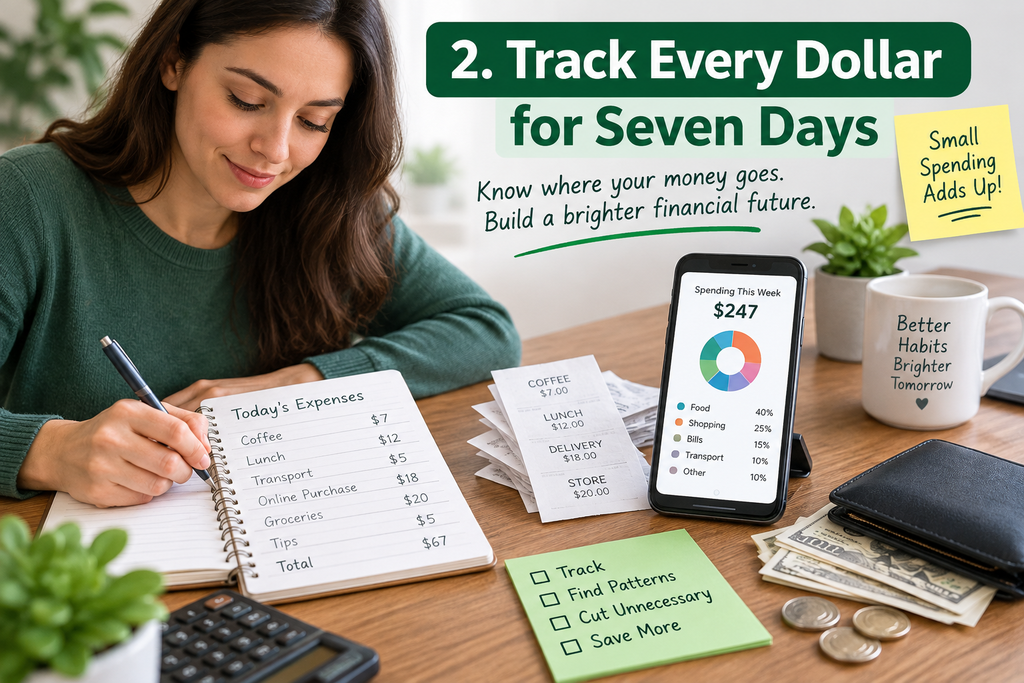
Keep a record of all your expenses for seven consecutive days—including various bills, cash purchases, tips, online orders, miscellaneous shop purchases, and automated payments. The goal here is not to blame yourself, but to identify specific spending patterns or habits. For instance, you might notice that you spend $100 a week on takeout because you lack the energy to cook after returning from work. Alternatively, you might discover that your biggest expense isn’t food, but rather an unused membership or online shopping. Once you understand these spending patterns, it becomes much easier to devise ways to save money, as you can then focus directly on the expenses that are having the greatest impact on your budget.
3. Cut the Biggest Monthly Expenses First
One of the biggest mistakes people make when figuring out how to save money fast is focusing only on tiny expenses. Skipping a $4 coffee might help a little, but adjusting a monthly expense of $150 could have a much greater impact. Therefore, start by focusing on your major, recurring expenses—such as housing, transportation, insurance, loan installments, food, utility bills, and costs for regular services.
Data from the BLS clarifies why this matter is significant. In 2024, the average consumer household spent $26,266 on housing and $13,318 on transportation. Combined, these two categories accounted for more than half (over 50 percent) of their average annual expenditure. However, this does not imply that every household must relocate or sell their car; such decisions depend largely on factors like location, employment, family needs, and various contractual obligations. What it essentially means is that those seeking quick ways to save money should examine their major expense categories before obsessing over smaller purchases.
4. Make a 30-Day No-Spend Challenge
A 30-day no-spend challenge can be a useful way to learn how to save money fast because it creates a temporary boundary around discretionary spending. The goal is not to stop paying essential bills or to avoid necessary purchases. Rather, it is to temporarily halt or drastically cut back on discretionary expenses—such as dining out, impulse buys, recreational shopping, unnecessary delivery orders, and random online purchases.
For instance, an American family typically spends $300 a month on dining out, coffee shops, entertainment, and impulse purchases; cutting back on these expenses for a month could result in savings of several hundred dollars. Since spending habits vary from family to family, the rules of a “no-spend challenge” should not be so strict that they seem unrealistic. During this period, you can still enjoy free activities such as hiking, visiting public parks, cooking with friends, borrowing books from the library, or watching movies at home. The primary goal of saving money quickly is not to impose a punishment, but rather to create a short-term arrangement where a significant portion of your income remains in your account.
5. Reduce Your Grocery Bill
For many households, groceries are an obvious place to look when considering how to save money fast. Food is essential, so the goal is not to eat less or choose unhealthy options. Instead, the aim is to minimize waste, plan purchases, compare prices, and keep the food you buy usable for a longer period.

Before heading to the market, thoroughly check your refrigerator, freezer, and pantry. Plan your meals based on the ingredients you already have at home. Make a shopping list and try to avoid shopping on an empty stomach. Instead of looking only at the price printed on the package, compare the price per unit; a larger package may weigh more, but the cost per unit is not always lower. If the quality meets your standards, you can also opt for store-brand products. Reducing your monthly grocery bill by just $75 would result in an annual saving of $900. When looking for ways to save money quickly, consistent monthly savings are far more effective than one-off strategies.
6. Cook More Meals at Home
Cooking at home is another practical answer to how to save money fast, especially if restaurant and delivery spending has become part of your routine. You don’t have to be a professional chef. Simple dishes like tacos, pasta, rice bowls, chili, roasted vegetables, sandwiches, soups, and grilled chicken can be prepared in large batches and used for multiple meals.
Consider an employee who spends $15 on lunch three times a week. This amounts to a weekly total of $45, or approximately $180 over a four-week month. Without making drastic lifestyle changes, one can save a significant amount of money simply by bringing meals from home instead of buying food outside. Additionally, preparing breakfast at home, carrying one’s own coffee, and packing easy-to-eat snacks can eliminate the need to make quick, impulsive purchases from shops whenever hunger strikes. For those seeking ways to save money quickly, food-related expenses represent an area where even minor adjustments to daily habits can yield immediate, tangible benefits.
7. Cancel Unused Subscriptions
It is easy to overlook subscriptions, as the cost of each payment may seem insignificant. A $9.99 streaming service, a $15 fitness app, an $8 cloud storage plan, and a $12 membership—viewed in isolation, none of these appear to be major expenses. Yet, when combined, these recurring costs can quietly add up to a substantial bill by the end of the month.
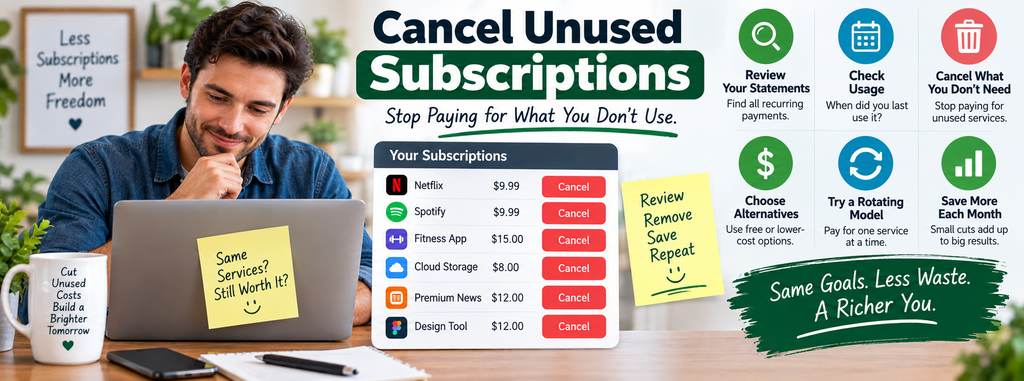
Review your bank and credit card statements and identify every recurring payment. Ask yourself when you last used each service. If there is a service you haven’t used for months, cancel it. If you use a service only occasionally, consider cost-effective alternatives or a “rotating subscription” model instead of paying for everything simultaneously. Learning how to save money fast often involves removing expenses that continue automatically even when they no longer provide much value.
8. Negotiate Your Bills
Another useful strategy for how to save money fast is asking whether your recurring bills can be reduced. Depending on your situation, you can negotiate or discuss the costs of services such as internet, phone, insurance, or others. Some companies offer special deals (promotional rates), low-cost plans, discounts, or various types of packages.
Before making the call, research the offers from competing companies and have a clear idea of your current expenses. Then, ask them if there are any lower-cost alternatives available. You do not need to be aggressive or harsh; instead, you can start the conversation with a simple question, such as, “Is there a cost-effective plan that meets my needs?” Saving just $30 a month adds up to $360 over the course of a year. When looking for ways to save money quickly, it is important to prioritize recurring or long-term savings, as a successful negotiation can provide benefits month after month.
9. Review Your Insurance Costs
Insurance protects you against significant financial loss, but that does not mean you are stuck with the same premium forever. Before renewing your insurance, review your car, renters, homeowners, and other relevant insurance policies, and compare the available options.
However, be cautious: low-cost coverage does not necessarily mean good coverage. Before switching to another policy, carefully compare deductibles, coverage limits, exclusions, and key protection features. A policy that saves you $20 a month but fails to provide adequate protection could lead to major problems down the line. The smarter lesson from how to save money fast is to reduce unnecessary costs without sacrificing essential protection.
10. Use Your Car More Strategically
Transportation can be one of the largest expense categories for an American family. According to a BLS report, transportation accounted for 17.0 percent of average consumer unit spending in 2024. That makes transportation an important category when considering how to save money fast.
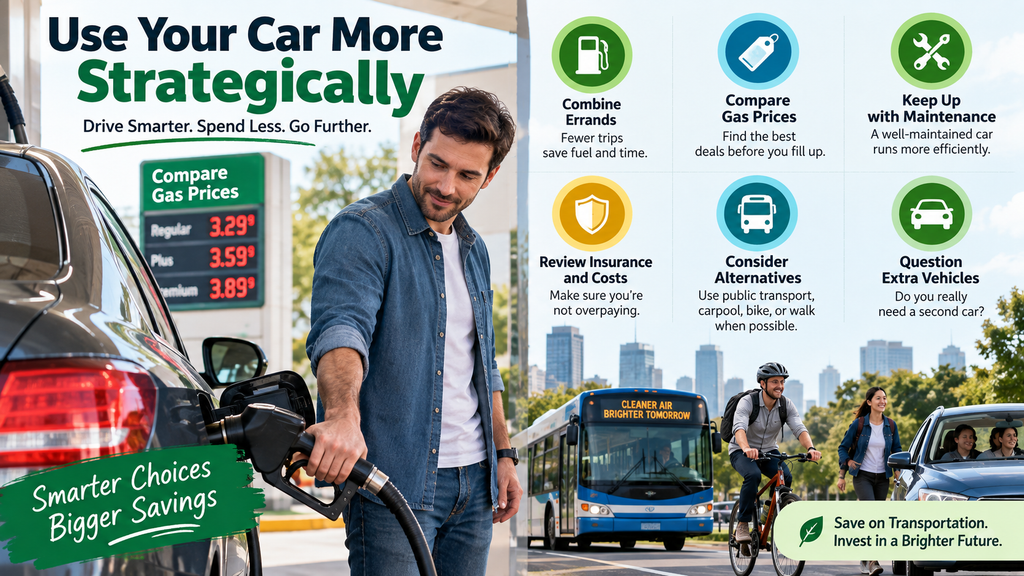
Instead of focusing solely on gas pump prices, consider factors such as fuel, parking, insurance, maintenance, registration, financing, and depreciation. Whenever possible, combine multiple errands into fewer trips. Compare gas prices before refueling. Whenever feasible, opt for alternatives like public transportation, carpooling, cycling, or walking. If you own multiple vehicles, assess whether both are truly necessary. While major vehicle-related decisions shouldn’t be based solely on short-term savings goals, your daily commuting choices can lead to significant savings.
11. Stop Paying Credit Card Interest
High-interest credit-card debt can make how to save money fast much harder because part of your money is constantly going toward interest instead of your savings goal. If you have any outstanding loans or balances, verify your interest rates and the outstanding amounts. Refrain from taking on any new, unnecessary debt while trying to improve your cash flow.
You can also evaluate whether your current debt repayment strategy is effective. Beyond covering essential expenses, paying more than the minimum installment can help reduce interest costs over time. Allocating a portion of any bonus or unexpected windfall toward paying off high-interest debt can improve your financial situation. Deciding whether to prioritize saving or debt repayment depends on your specific circumstances; however, ignoring high-interest debt while trying to build savings can lead to a cycle of financial distress.
12. Automate Your Savings
If you want to know how to save money fast without depending on willpower, automate the process. Set up an automatic transfer of funds from your checking account to a separate savings account after receiving your salary. When money is moved aside before you have the chance to spend it, saving ceases to be merely a task to be remembered at the end of the month and instead becomes an integral part of your overall financial management.
For instance, if you set aside $100 from your bi-weekly paycheck—without earning any interest or profit on it—you would accumulate a total of approximately $2,600 over 26 pay periods. If $100 seems like too much, you could start with $25 or $50 and increase the amount later as your budget or financial situation improves. The CFPB recommends building a separate emergency fund for unexpected expenses, noting that even a small amount of money can help people overcome financial crises. Automated savings can transform the goal of “saving money quickly” into a simple, regular habit.
13. Put Extra Income Directly Into Savings
Cutting expenses is only half of the answer to how to save money fast. Increasing your income can accelerate your progress, especially when cutting back on essential expenses proves difficult.
You might consider various options suited to your situation, such as working overtime, freelancing, taking shifts on days off, selling unused items, tutoring, pet sitting, delivery work, or any other legitimate source of income. You do not necessarily need to take on a permanent second job; even a temporary boost in income can help you reach a specific savings goal faster.
For instance, suppose you earn an extra $300 per month for three consecutive months and save the entire amount. This would add $900 to your savings goal without altering your regular income. If you can reduce expenses alongside this additional income, your progress could accelerate significantly. The key here is to avoid raising your standard of living immediately as your income increases.
14. Sell Things You No Longer Use
You likely have many items in your home that you previously paid for but no longer use. Take a good look through your closets, garage, storage areas, drawers containing electronics, and any furniture you are considering replacing. You can earn money by selling items such as clothing, unused electronics, tools, sports equipment, furniture, hobby collections, or anything else you no longer need.
Before listing an item for sale, decide exactly how you intend to spend the proceeds. Otherwise, it is all too easy to spend the money earned from selling a $200 item within just a week. If your goal is how to save money fast, transfer the proceeds to your savings account as soon as you receive them. The $500 obtained from clearing out (or selling) unnecessary items can be deposited as a meaningful contribution to an emergency fund, rather than being lost to daily expenses.
15. Use a 24-Hour Rule for Impulse Purchases
Emotions often drive the tendency to make spontaneous purchases, or ‘impulse spending.’ You might feel an urgent need to buy a new pair of shoes, an electronic device, home décor, or an item featured in an attractive online offer. However, following the ’24-hour rule’ can help curb this urge to buy impulsively.

For non-essential items, write them down on a list and wait at least one day before making the purchase. For major purchases, you might consider waiting up to a week. After this waiting period, ask yourself: do you still want to buy the item, and does it align with your current goals? This strategy is especially useful for anyone learning how to save money fast because it does not require eliminating all discretionary spending. It simply creates space between wanting something and paying for it.
16. Create a Small Emergency Fund
An emergency fund is central to how to save money fast because savings are not only about reaching a number. The primary objective of these funds is to prevent unexpected expenses from turning into new debt. According to the CFPB, an emergency fund consists of money specifically set aside for unforeseen costs or financial emergencies—such as unexpected repairs, medical expenses, equipment breakdowns, or a reduction or loss of income.
You do not need to build a massive emergency fund overnight; start with an amount that aligns with your current income and expenses. As your financial situation improves, increase the size of the fund and work towards a more ambitious goal. Keeping this money separate from your everyday bank account (checking account) makes it easier to avoid the temptation of spending it casually or unnecessarily. If you are serious about saving money quickly, creating such a ‘financial cushion’ can make any future adversity far less painful.
17. Give Every Unexpected Dollar a Job
Salary increments, bonuses, tax refunds, gifts, overtime pay, proceeds from sales, and other unexpected income can present a significant opportunity for you. Instead of assuming that every bit of extra money must be spent, decide in advance how you will allocate these funds.
For instance, suppose you receive a $2,000 bonus. You might decide to put $1,000 into savings, use $600 to pay off debt or address other important financial needs, and spend the remaining $400 on something enjoyable of your choice. While the specific proportions or amounts are entirely up to you, the underlying principle is highly effective: decide how to use the money before you actually spend it. This approach makes how to save money fast feel less restrictive because you can still enjoy part of the money while making meaningful progress toward your financial goal.
18. Try a Seven-Day Spending Reset
If you feel your expenses are spiraling out of control, a seven-day “reset” can help you quickly grasp the reality of your financial situation. During this period, pay essential bills and purchase necessities like food, transportation, medicine, and other urgent items, but refrain from making discretionary or non-essential purchases.
At the end of the week, review the areas where you avoided spending money. Then, consider which of these changes could realistically be sustained for another month. You might find that you can easily stick to habits such as bringing lunch from home three days a week, skipping a shopping trip, cancelling an unused subscription, or stopping the practice of ordering takeout on busy evenings. The purpose of how to save money fast is not to live permanently under extreme restrictions. A short reset can simply help you identify habits that deserve a permanent adjustment.
19. Use the 30-Day Savings Challenge
A structured savings challenge can make how to save money fast more motivating because you can see progress every day or week. Decide on a realistic amount and create a simple schedule. You might save $10 on Mondays and $20 on another day of the week, or set a fixed weekly savings amount based on your income.

Another approach is to integrate this savings challenge with your spending habits. For instance, if you skip dining out three times, set aside the money you would have spent on those meals into your savings. Save the proceeds from selling any unused items. Similarly, if you cancel a subscription, deposit that monthly cost into your savings account instead of letting it blend into your general expenses.
The most important thing is to avoid taking on difficult challenges that cannot be sustained in the long run. The method for saving money quickly should foster progress; it should not devolve into a cycle of extreme frugality followed by excessive spending.
20. Build a System You Can Keep
The final lesson in how to save money fast is that speed matters, but sustainability matters too. You might feel highly successful after cutting back on all discretionary spending for two weeks, but if you revert to old habits afterward, your financial situation could quickly return to its previous state.
A better approach is to establish a sustainable system rather than relying on short bursts of strict saving. Automate your savings process. Keep track of major expenses. Periodically review your subscriptions and services. Plan your grocery shopping. Limit impulse or emotional purchases. Regularly check your bills. Allocate any unexpected income toward your priority financial goals. According to recent data from the BEA, the personal saving rate in the United States was 3.0% in July 2026; this demonstrates that the amount Americans save relative to their disposable income can fluctuate over time. Your personal savings target does not necessarily have to align with the national average; what truly matters is establishing a saving rate that suits your specific circumstances.
A Simple 30-Day Plan for Saving Money Fast
If you are still wondering how to save money fast, you do not need to implement everything in this article on the same day. Start with a simple 30-day plan. During the first three days, review your bank and credit card statements to identify major spending categories. Then, select three immediately actionable steps—such as cancelling unused subscriptions, cutting back on dining out, and setting up automatic transfers to your savings account.
In the following week, plan your meals, carry a shopping list, review recurring bills, and apply the “24-hour rule” for non-essential purchases. During the second week, look for additional sources of income and sell items you no longer need. In the third week, assess your progress and move your accumulated savings into a dedicated savings account. Finally, in the last week, calculate your total savings and decide which changes you wish to maintain in the future.
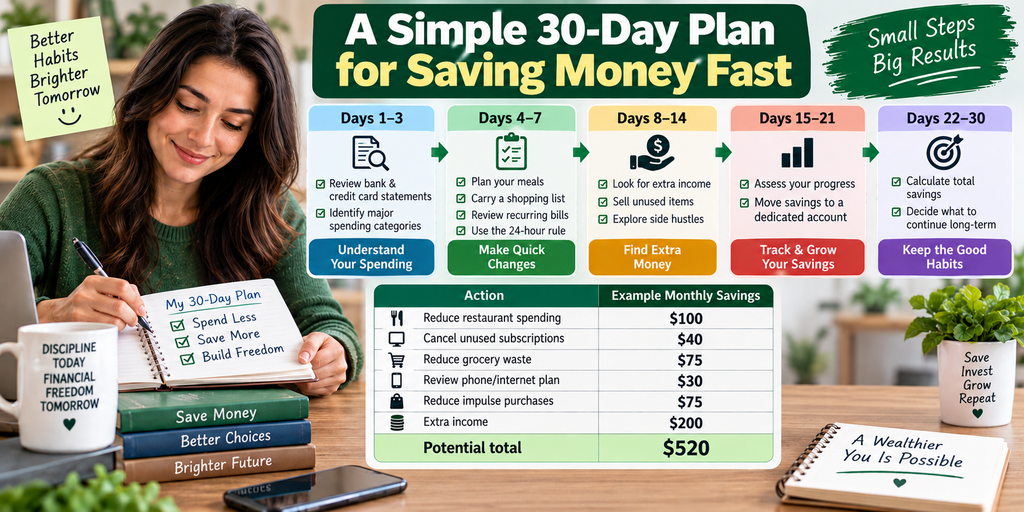
The unique feature of this method is that it makes the resulting cost savings measurable. You are not merely hoping to spend less; rather, you can clearly see exactly how much money remains in your account as a result of your decisions.
| Action | Example Monthly Savings |
| Reduce restaurant spending | $100 |
| Cancel unused subscriptions | $40 |
| Reduce grocery waste | $75 |
| Review phone/internet plan | $30 |
| Reduce impulse purchases | $75 |
| Extra income | $200 |
| Potential total | $520 |
These are merely examples; there is no guarantee that they will definitely result in cost savings. Your actual results will depend on your income, location, family size, existing contracts, debts, and spending habits. The key point is that a few small steps or changes, when combined, can quickly lead to significant savings.
What Should You Do With the Money You Save?
Once you understand how to save money fast, give the money a clear destination. If you lack savings for emergencies, prioritizing the creation of a cash reserve would be a prudent move. Conversely, if you are burdened with high-interest or substantial debt, paying it off becomes a priority. However, if you already possess adequate emergency funds and manageable debt levels, you can utilize any surplus savings to work towards long-term financial goals.
It is a mistake to spend or squander extra funds simply because your checking account balance looks high. To maintain discipline in your financial management, establish separate accounts or categories for different objectives. For instance, you could maintain distinct funds for emergencies, car repairs, travel, and long-term investments. Rather than blindly copying the percentages or timelines followed by others, you should formulate a strategy tailored to your specific financial situation.
Conclusion
Learning how to save money fast is less about finding one magical money-saving trick and more about combining several practical actions. Start by setting a specific goal and tracking your expenses. Next, cut down on major recurring costs while also controlling spending on groceries and dining out; cancel unused subscriptions, review your bills, and automate your savings process. Then, look for ways to increase your income, sell unused items, and allocate any unexpected funds toward your financial priorities.
Remember, saving quickly does not necessarily require extreme austerity or severe frugality. A realistic plan that helps you save $300 or $500 a month can be more effective in the long run than a plan that might yield $1,000 in savings once but proves unsustainable over time. Data from the United States shows that households spend significant amounts on major categories like housing, transportation, and food; therefore, focusing on these large, significant expenses can be far more productive than obsessing over every minor purchase.
If you are serious about how to save money fast, start today with one action: move a specific amount into savings, cancel one unused expense, or identify one way to earn extra income. Then, repeat the same process tomorrow. Saving money becomes much easier when your decisions turn into a systematic routine.
FAQs About How to Save Money Fast
1. How can I save money fast on a low income?
If you have a limited income, first identify your essential expenses and then focus on areas that are actually within your control. Keep track of your spending, cut down on unnecessary recurring bills, cook more meals at home, avoid impulse buying, and consider temporary ways to earn extra income. When researching how to save money fast, remember that even small weekly savings can become meaningful when you consistently protect them from everyday spending.
2. How can I save $1,000 quickly?
Break down the $1,000 goal into smaller, manageable steps to get started. You could aim to save approximately $250 each week over a four-week period, or combine cost-cutting measures with ways to generate extra income. For instance, you might save $300 by cutting unnecessary expenses, earn $400 from a temporary side job, and raise $300 by selling unused items. You will need to determine the best approach based on your specific circumstances.
3. What is the fastest way to start saving money?
Preventing the automatic outflow or spending of money is one of the quickest and most effective measures you can take. Review recurring subscriptions, check recent transactions, set limits on short-term spending, and arrange for automatic fund transfers into savings. This allows you to establish an effective system immediately, without relying solely on willpower.
4. Should I save money or pay off credit-card debt first?
There is no single answer that applies to everyone. Setting aside funds for emergencies can prevent minor, unexpected expenses from turning into a new debt burden; conversely, mounting credit card balances can become extremely costly due to high interest rates. Consider factors such as interest rates, emergency savings, income stability, and financial obligations when deciding how to allocate your funds.
5. How can I make saving money a permanent habit?
Automation is one useful starting point. Schedule savings shortly after payday, keep emergency savings separate from everyday spending, review your expenses regularly, and increase your savings when your income rises. The best long-term answer to how to save money fast is to combine an initial burst of saving with habits you can realistically maintain.